

The Blood Brain Barrier (BBB)

The blood brain barrier (BBB) - The CNS "Gatekeeper"
The blood-brain barrier is a highly effective security network that protects the CNS (brain and spinal cord) from harm
The BBB was first recognized by Paul Ehrlich in 1885 during experiments injecting mice with dye, where the dye could not penetrate into the brain and spinal cord, later proved by Edwin Goldmann. We now understand that only small molecules that are both lipid soluble and have a molecular weight < 400 Daltons can cross the dynamic, so-called semi-permeable, BBB – in other words, most macromolecules cannot penetrate the brain capillary endothelium (lining their lumen).
The BBB has many functions, including ensuring a homeostatic environment in the CNS / brain – controlling the correct transport of ions and molecules (such as nutrients and signaling molecules (e.g. hormones)), into and out of the CNS, ensuring an exit route for toxins back into circulation, protecting the brain from harmful organisms and foreign substances and allowing passage of newly synthesized hormones from the hypothalamus to the pituitary glands.
Molecules with a high electrical charge are slowed when passing through the BBB and other large molecules have difficulty passing through the BBB. Also, less fatty molecules do not cross so well. In contrast, barbiturates that are lipid-soluble penetrate the BBB rapidly.
Cells of the BBB
The four cell types that follow the vasculature of the CNS (brain and spinal cord) are:
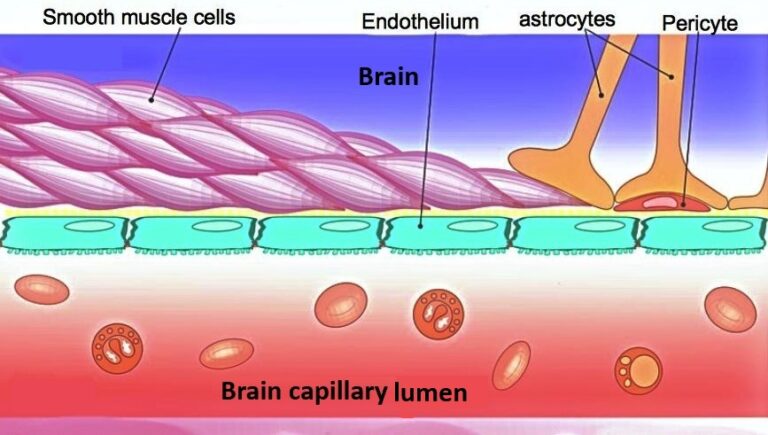
- Endothelial Cells. These tightly packed cells, considered the structural core of the BBB, comprise the inner membrane of blood-carrying capillaries (micro vessels) in the brain and not only provide integrity of the inner walls, but also filter what substances are allowed to pass in and out of the brain through the small gaps (cellular junctions) between them.
- Pericytes. Embedded in the basement membrane of micro vessels, these immune-like cells identify and destroy harmful organisms in the blood. In addition to lending structure to micro vessel integrity, pericytes influence its growth and permeability.
- Astrocytes – These star-shaped glial cells in the CNS provide nutrients for neurons, regulate blood flow, maintain ion balance and have crucial roles in brain function support and astrocytes recruit white blood cells (leukocytes and monocytes) into the CNS to help repair injuries.
- Microglia – Microglia are first line of defense immune cells in the CNS. Located just outside the BBB, microglia detect and destroy harmful organisms / foreign bodies that “made it through” the BBB. Few antibodies are small enough to cross the BBB, so microglia act as antigen-presenting cells to activate immune system T-cells.

Transport routes across the BBB into the CNS
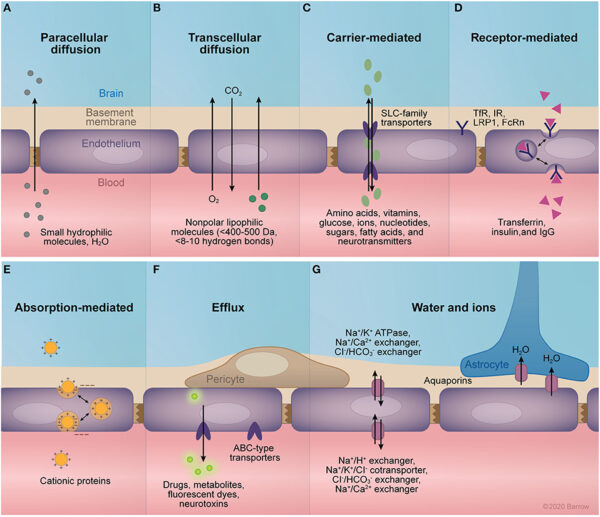
Various nutrients, microbes and toxins are transported in the blood, but only certain substances can cross the BBB without intervention:- Via channels as a transporter: Small ions e.g. Na+ / K+ / Cl-, Water (H2O)
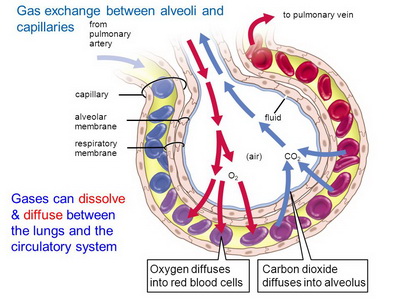
- Via the cell membrane as a transporter: Small lipophilic (fat-loving) molecules e.g. CO2 and O2, nicotine, caffeine, cannabis, barbiturates, anesthetic. ethanol
- Via solute carriers or carrier-mediated transport: creatine, monocarboxylates, pyruvate, lactate, glucose (GLUT-1 transports glucose into CNS)
- Via receptor-mediated transport: Leptin, ghrelin, insulin, transferrin, IgG
- Via active efflux transporters: MRP 1,2,4,5, P-glycoprotein, BRCP
Which nutrients have good evidence for being able to cross BBB?
Most promising:
- Omega‑3 fatty acids
- Polyphenols (curcumin, resveratrol)
- Magnesium‑L‑threonate
Supportive but inconsistent data
- Vitamin E
- Vitamin D
- Phosphatidylserine
How do microbes or toxins get past the BBB?
A healthy blood-brain barrier protects the CNS from undesirable peripheral blood cells, microorganisms, and toxins. However, some situations can weaken the BBB integrity – “opening a door” into the CNS and allowing entry of pathogenic organisms, proteinaceous fluid and toxins:
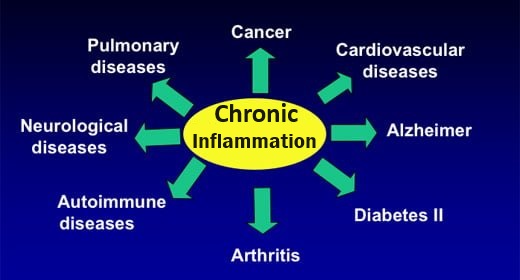
- Inflammation.
- Aging. Zhou et al, 2016
- In-utero development. The forming BBB is vulnerable as the fetus is forming.
- An excessive amount of glucose or sodium in the blood (Hyperosmolarity). Can force the BBB to open.
- Microbial infection. Bacteria, viruses and protozoa, can cause direct or indirect immune-mediated damage to the BBB, increase its permeability. Some of the better-known culprits are – viral infections: herpes simplex virus (leads to H. simplex encephalitis), varicella zoster virus (chickenpox, shingles), HIV, Japanese encephalitis virus and SARS-CoV-2 (Covid 19). bacterial infections Treponema pallidum (syphilis), E. Coli K1 and other bacteria (Meningitis – inflammation of the meninges); protozoan infection: Toxoplasma gondii (encephalitis)
- High blood pressure (HBP). Hypertension is a major cause of opening the BBB.
- Acute ischemic stroke (AIS)
- Head trauma. E.g. an accident, fall, or other injuries that cause ischemia, pressure, or inflammation of the brain can cause the BBB to open.
- Radiation. Radiation exposure of between 10 to 15 Gy (Grey) severely compromised the integrity of the blood-brain barrier.
- Microwaves. Excessive microwave exposure can affect the BBB and compromise its integrity.
Circumventricular Organs (CVOs) in brain do not have a BBB
Circumventricular organs in the brain contain highly permeable capillaries (without a BBB), an integral part of the neuroendocrine system, they act as an alternative route for peptides and hormones between blood and neural tissue. CVOs assist the brain in assessing contents of the blood and make decisions based on their findings.
The circumventricular organs are:
- The vascular organ of the Lamia Terminalis – This area identifies different molecules and peptides.
- The Area Postrema – The vomiting center of the body. When you eat or drink something toxic, and it enters the bloodstream, the area postrema will make the body throw up to try and eliminate the substance from the gut.
- The Subfornical Organ – Responsible for regulating fluids in the body.
- The Neurohypophysis – The posterior pituitary gland is responsible for releasing the neurohormones vasopressin and oxytocin into the bloodstream.
- The Median Eminence – Releases neurohormones and regulates the anterior pituitary gland.
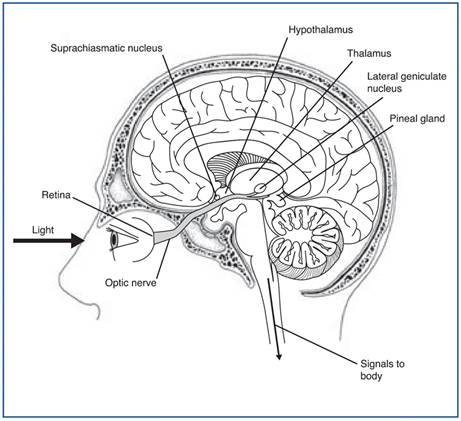
- The Pineal Gland – This endocrine gland is responsible for secreting neuroactive peptides and MELATONIN and helps regulate the circadian rhythm.
Techniques to enable treatment substances to cross the BBB
Three general mechanisms
In its brain-protective role, the BBB has been a great hurdle for brain drug delivery. Given that only small, lipid molecules can cross the BBB, the following 3 mechanisms are being used to carry treatment substances across the BBB to fight infections or correct imbalances in such as stroke, diabetes, seizures, M.S., Parkinson’s and Alzheimer diseases.
- The Trojan Horse Route – Using an infected phagocyte
- The Transcellular Route – Passing through lipid structures
- The Paracellular Route – Passing through the space between epithelial cells
Invasive techniques used to cross the BBB
Transient disruption. A therapeutic substance is combined with a brain permeability enhancer, which briefly shrinks the tightly packed epithelial cells, widening the junctions / openings between them sufficiently and for sufficient time to allow larger-than-usual therapeutic molecules to pass through. This has the potential for harming the CNS by allowing an in-road for neurotoxic agents, xenobiotics, and unwanted components in the blood. This invasive method requires the use of hyperosmotic solutions, or agents such as:
- X-Irradiation
- Metals
- Ethanol
- Dimethyl sulphoxide
- Glycerol
- Mannitol
- Polysorbate-80
Intrathecal and intra cerebrovascular infusions. Therapeutics are delivered by direct injection into the cerebrospinal fluid via a lumber puncture or an IDDD – (intrathecal drug delivery device).
Non-invasive techniques used to cross the BBB
These methods do not forcefully alter the blood-brain barrier or require any surgery.
Microbubble-enhanced diagnostic ultrasound (MEUS) and Focused ultrasound (FUS)
Lipid soluble enhancement via drug modification. Water-soluble molecules are changed into lipid-soluble molecules that can cross the BBB.
Hiding on a carrier or transport system. By the chemical modification of a small molecule drug, it can be made to mimic the structure of an endogenous molecule such as –
- Large neutral amino acids
- Purine bases
- Monosaccharides
- Acidic amino acids
- Monocarboxylic acids
- Nucleotides
- Hormones
- Amines
Efflux transporter Inhibitors. This method prevents or inhibits efflux transporters expressed by the cerebrovascular endothelium, effectively preventing the brain from taking up the drug via the blood. There are a few types of transporters commonly inhibited, namely –
- Breast cancer resistance proteins
- Multidrug-resistant proteins
- P-glycoprotein
The Trojan Horse Method. This strategy using nanotechnology disguises therapeutics as “cargo” on a carrier that will cross the BBB, enabling the treatment substance to cross.
The Chimeric Peptide Method. This method is formulated through a disulfide bond by making a covalent coupling of a non-transportable drug to a BBB transportable peptide transmitter, such as transferrin, insulin, catatonized albumin. The chimeric peptide is transported to the brain via the capillary endothelial cells through receptor-mediated transcytosis. The therapeutic peptide that is now pharmacologically active is cleaved from the peptide vector because of the brain’s disulfide reductase. The peptide receptor system of the blood-brain barrier includes receptors for transferrin, leptin, and insulin-like growth factor, including the disulfide reductase for the rapid joining of the chimeric peptides.
The pro-agent bioconversion method. A precursor to the active agent that is small enough to cross the BBB, where it is then chemically / enzymatically converted to its therapeutically active form
The nanoparticle method. Using nano scaled, controlled release drug delivery technology, certain drugs can be released directly into the brain through different platforms such as polymer- or lipid-based nanoparticles
Foods / Supplements that help maintain a healthy BBB
The blood-brain barrier can become hyper-permeable and leak, especially after a traumatic accident or injury that caused brain trauma. Some nutrients can help repair the BBB
Magnesium
Magnesium supplement magnesium-L-threonate and foods high in magnesium:
- Spinach
- Pumpkin seeds
- Avocado
- Bananas
- Dark chocolate
- Chard
- Chicken liver
- Beef liver
- Almonds
- Ostrich meat
- Broccoli
- Brussel sprouts
References
Practical Psychology. (2022, August). What Can Cross the Blood Brain Barrier?. Retrieved from https://practicalpie.com/what-can-cross-the-blood-brain-barrier/.
https://bmcneurol.biomedcentral.com/articles/10.1186/1471-2377-9-S1-S3
https://fluidsbarrierscns.biomedcentral.com/articles/10.1186/s12987-020-00230-3
https://www.frontiersin.org/articles/10.3389/fnins.2017.00224/full
https://asm.org/Articles/2020/April/How-Pathogens-Penetrate-the-Blood-Brain-Barrier
https://www.ncbi.nlm.nih.gov/pmc/articles/PMC5858162/https://www.healthline.com/nutrition/11-brain-foods
Zhou W, Zhang J, Wang G. et al. Permeability and distribution of nerve growth factor in the brain of neonatal rats by periphery venous injection in hypoxic-ischemic state. Springerplus. 2016;5:1893. doi: 10.1186/s40064-016-3594-2. PMC free article PubMed