
Vertebral Column

Vertebrae (bones)

  • Cervical (7 vertebrae): Located in the neck.
  • Thoracic (12 vertebrae): Located in the upper and mid-back.
  • Lumbar (5 vertebrae): Located in the lower back.
  • Sacral (5 fused vertebrae): Located in the pelvic region.
  • Coccygeal (4 fused vertebrae): Forming the coccyx or tailbone.

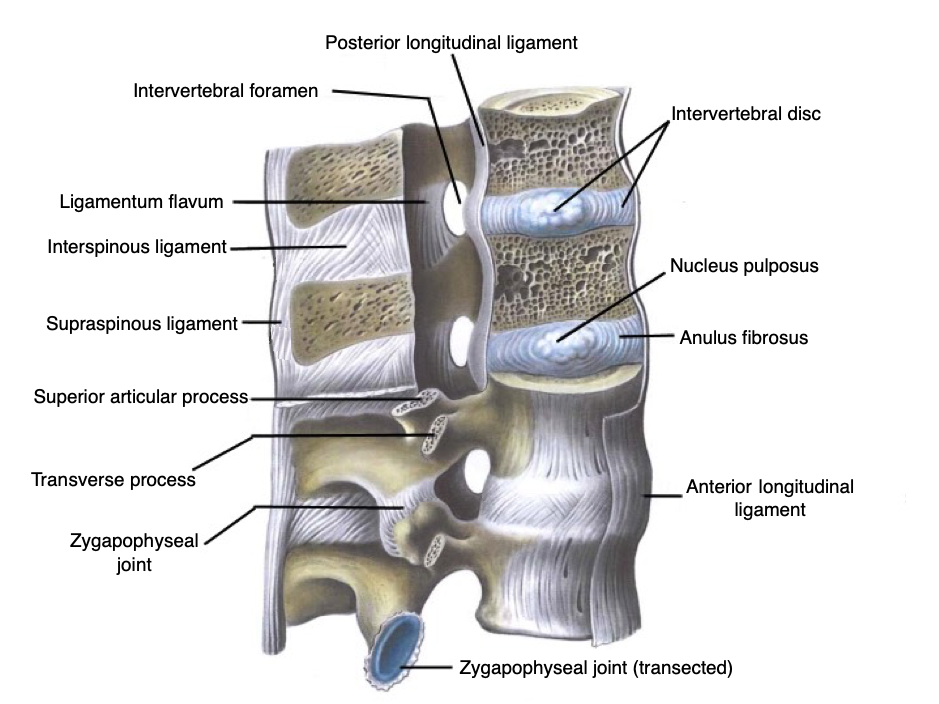
Posterior longitudinal ligament.  Separates invertebral discs from tubal spinal cavity / canal, which houses and protects the nerve-carrying spinal cord, from base of skull to lower back..

Meninges.   3 protective membranes surround spinal cord

Invertebral discs.   Providing cushioning and flexibility, a connective, spinal disc, composed of strong elastic tissues, separates each vertebra.  When the spine bends or rotates, these spinal discs allow smooth, low-friction movement between adjacent vertebrae. Each disc contains a soft inner substance with a surrounding outer layer, which maintains the structure of the disc.

When the tough outer portion of the disc weakens, it is possible for the gel-like center of the spinal discs to bulge outwards into the spinal canal.

In more severe cases, it can lead to a herniated disc. A herniated disc occurs when a tear in the outer layer of the disc allows the inner substance to leak into the spinal canal.


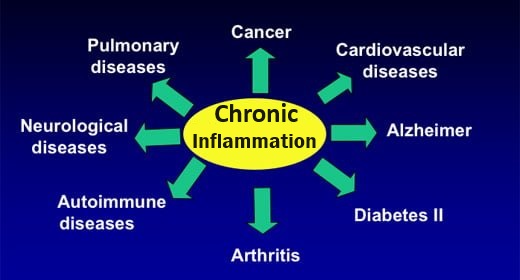
Chronic low-level inflammation

  • Detoxifies
  • Boosts immune system / cellular energy
  • Anti-inflammatory / Pain-relief
  • Aids sleep / Reduces stress
  • Accelerates healing of tissue, bone, muscles, scars
  • Improves circulation +++

Successful electrotherapies

Anatomy-related:

Cervical spine

Cervical spine

Vertebral Column Vertebrae (bones) Cervical (7 vertebrae): Located in the neck. Thoracic (12 vertebrae): Located in the upper and mid-back. Lumbar (5 vertebrae): Located in the lower back. Sacral (5 fused vertebrae): Located in the pelvic region. Coccygeal (4 fused vertebrae): Forming the coccyx or tailbone. Posterior longitudinal ligament.  Separates invertebral discs from tubal spinal cavity / canal, which houses and… Continue reading Cervical spine...
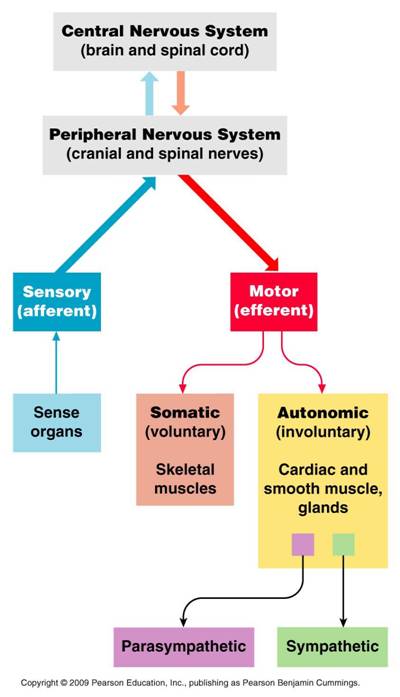
Nervous system 101

Nervous system 101

Overview of our body's nervous system...
The Human Cell 101

The Human Cell 101

The smallest functional unit of tissues and organs, the cell can take in nutrients, convert these nutrients into energy, carry out specialized functions, and reproduce...
Cellular Respiration

Cellular Respiration

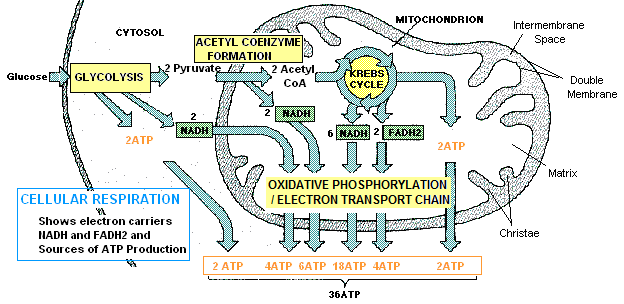
The purpose of cellular respiration is to harvest high-energy ELECTRONS from glucose, with which to produce ATP Energy. This is accomplished by a 4-step process, which oxidizes the Carbons of glucose to Carbon Dioxide and Water.t...
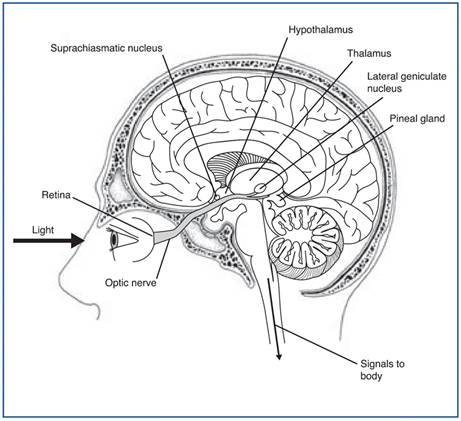
Biological Clock

Biological Clock

The master "Biological clock" is the pacemaker of our body's 24 hour circadian rhythms . It not only controls our sleep / wake cycles, but also maintains the immune system and balances our emotions...
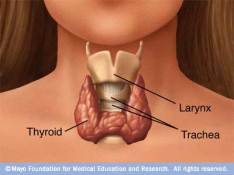
Thyroid Gland

Thyroid Gland

Thyroid hormone production depends on 3 key components...