Cyanobacteria may have a role in ALS / PDC (amyotrophic lateral sclerosis / Parkinsonism dementia complex)
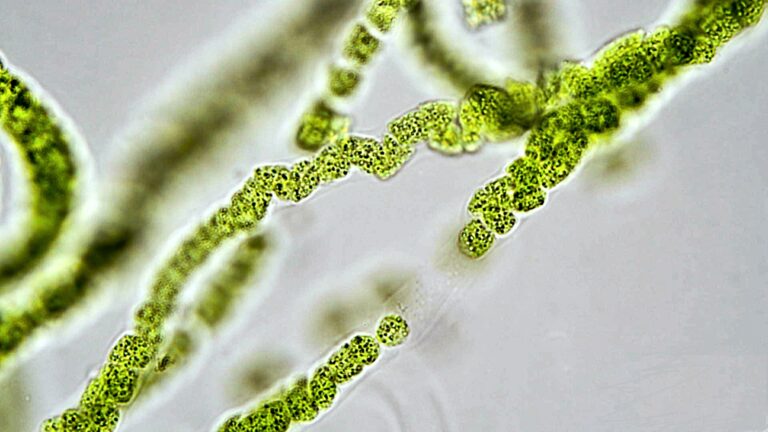
Cyanobacteria live inside aerial roots of cycad tree. Dr. Paul Cox PhD (Harvard) discovered that the indigenous people of Guam were making flour (rich in the neurotoxin BMAA from the seed kernels of these roots, with an associated rate of ALS much higher than other people (About 25% of the population dying, compared to about 0.3% in America). Some of the people showing typical ALS symptoms, some signs of dementia and others Parkinson tremors, some all three.
The flying fox bat eats the cycad seeds and concentrates the BMAA toxin in their tissues up to 10,000 times. The Chamorro in the Pacific island of Guam traditionally love to eat these bats. With this connection, Dr. Cox’s research with Dartmouth college, NH in New England found higher ALS rates around lakes polluted with nutrient discharges with cyanobacteria blooms), but not pristine waters. Cyanobacteria thrive on nutrient-rich environments, higher CO2 levels and warmer temperatures. The Cox team determined that the risk for ALS increases 25-fold for those living near these blooms.
ALS, Parkinson’s and dementia are so-called tangle diseases, consequential to mis-folded, tangled proteins (amyloidosis). Cox and his team found out that cyanobacteria can cause or contribute to this entanglement.
A 2022 Serbian paper of over 200 studies over 30 years of BMAA involvement in neuro-degenerative diseases concludes that Cyanobacteria may be a contributing factor speeding up ALS / PDC progression rather than being the cause or initiator. The follow reasons are cited in the conclusion: >90% of experiments use pure / synthetic BMAA, which differs in its effects of natural BMAA, which is combined with compounds having potentially synergistic bearing on results. The common route of exposure is probably oral which was applied in only 20% of studies. BMAA involvement is likely chronic, 84% of studies were done under short-term exposure. Relatively high concentrations were required to produce neurodegenerative effects. 2022 Serbian study



 for Physical / Mental Health: Magnesium,
Omega-3 ,
C,
D,
Iodine in
“Make-it-Happen” smoothie
for Physical / Mental Health: Magnesium,
Omega-3 ,
C,
D,
Iodine in
“Make-it-Happen” smoothie