Fibrocystic changes (FCCs) in breasts
Overview
What are FCC’s?
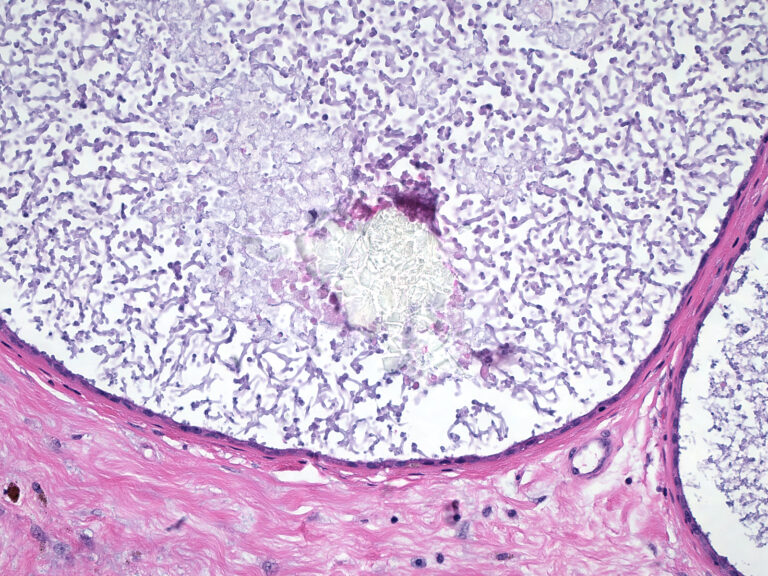
Fibrocystic changes (FCCs) in breasts (also called fibrocystic breasts, and formally called “Fibrocystic disease of the breast”) define the presence or development of benign lumpy and/or ropey tissue in one or both breasts. These lumps or nodules result from an excess number of cells that grow in the breast. It is believed that the increase in cells is due to hormonal stimulation during the menstrual cycle due to a predominance of estrogen over progesterone.
Not uncommon, ~90% of American women have FCCs. Of these women, 40% are unaware they have them. FCCs generally affect premenopausal women aged 20-50.

FCC symptoms
Typical symptoms include:
- Breasts feel heavy, lumpy or like ropey bumps;
- Tenderness / redness / swelling in the breast;
- Pain under the armpit.
Ultrasounds can be used to monitor changes to the breast. Solid-feeling lumps may be further investigated with a biopsy to rule out cancer.
Do FCCs increase risk of breast cancer (BC)?
- Nonproliferative lesions. 70% of breast cancer screening biopsies; includes cysts, periductal fibrosis, nonsclerosing adenosis, duct ectasia, epithelial-related calcifications, mild epithelial hyperplasia, papillary apocrine changes
- Proliferative lesions without Irregular, abnormal or non-standard cells (the medical term for abnormal cells is atypia). includes sclerosing adenosis, radial scar, intraductal papilloma, and moderate to florid hyperplasia;
- Proliferative lesions with Irregular, abnormal or non-standard cells (referred to as atypical hyperplasia). Includes atypical ductal hyperplasia and lobular hyperplasia. For perspective, >80% of women diagnosed with this type of lesion will NOT develop invasive breast cancer.
- Majorly predicted by type of FCCs. Atypical hyperplasia had a relative risk of 4.24, proliferative lesions without atypia 1.88 and nonproliferative lesions 1.27.
- Degree of family history of breast cancer (BC):
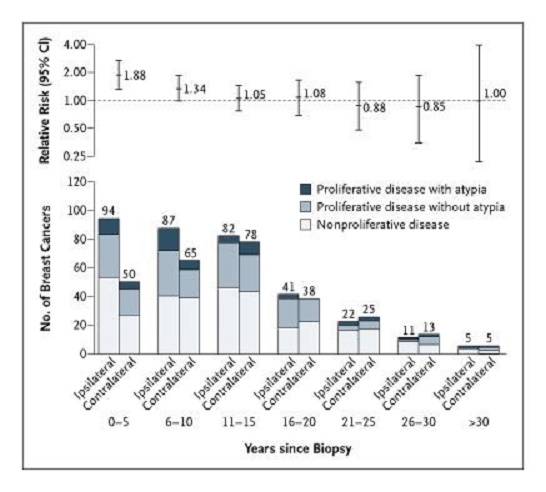
Over the last 80 years, hundreds of publications have confirmed statistical correlations between advanced fibrocystic breasts and subsequent breast cancer. i.e. The longer fibrocystic tissue is present in a breast, the higher the potential risk for developing breast cancer.
Accumulation of toxins in the breast may occur due to overuse of deodorants or from a tight-fitting bra which prevents proper lymph drainage from the breast
Ensuring sufficient iodine is a "no brainer" solution against FCC and breast cancer
Iodine is the trigger mechanism that promotes appropriate cell death
To keep the cell count steady in the breasts, some cells have to be removed each month. Leftover cells that have not been appropriately destroyed build up over repeated cycles and cause the lumpy, tender breasts, and larger fibrocystic lesions.
The breasts concentrate iodine when available. Several studies have demonstrated a relationship between low iodine intake and FCCs both in women and laboratory animals. A sufficiency of iodine eliminates the excess cells, enabling the breast to return to its normal resting state as the fibrocystic lumps slowly disappear from the breast.
Check out this lecture by Dr. David Brownstein about iodine and its deficiency relationship to breast cancer:
http://www.youtube.com/watch?v=tZJ9Bcqjgzc
If you discover you have FCCs at the age of 45-55, it is likely you have had it for many years, and there is a possibility that the cells may become cancerous. The good news is that it can be cleared up completely with a daily intake of iodine. Derry, DM, Breast Cancer and iodine Preventing and surviving,Trafford Publishing company, Canada, 2001.
FCCs treated with Iodine Supplementation. In 1993 Ghent and Eskin published a landmark paper on the treatment of severe fibrocystic breasts with iodine supplements. This paper was the result of more than 30 years of research by Dr. Bernard. A. Eskin of the Medical College of Pennsylvania in Philadelphia. First in animals and then in humans, he proved fibrocystic breasts are the result of low dietary iodine. He has also shown that fibrocystic breasts can go on to develop into breast cancer. Ghent et al, 1993; Eskin et al, 1995; Eskin, 1970; Eskin, 1983; Eskin, 1976; Eskin et al, 1986
Iodine addresses potential environmental causes of FCCs / breast cancer
Pesticides, microbes, toxins, etc. If a person has enough iodine in the body, the toxins cannot do much damage because iodine does an excellent job of deactivating toxins.
Environmental estrogen look-alikes (xenoestrogens). It is likely that iodine helps eliminate FCCs (and ovarian cysts) at least partly through it’s interaction with estrogens. Iodine helps the body to metabolize estrone (a slightly carcinogenic human estrogen, high levels may contribute to tumor growth in breast cancer) and 16-alpha-hydroxyestrone (a much more dangerous metabolite of human estrogen) into estriol, an “anti-carcinogenic” or at the very least “neutral” form of human estrogen.
What is the iodine dose for FCCs?
Prevention of FCCs. Based on their studies of iodine in women and female rats, Ghent et al and Eskin have estimated that the amount of iodine required for protection against breast cancer and fibrocystic breasts, is at least 20 to 40 times the amount required for control of goiter. Therefore, the MINIMUM amount of iodine required for control and prevention of fibrocystic breasts is equivalent to 0.1 mg / kg body weight / day (this is the amount used by Ghent et al, 1993).
E.g. the minimum daily amount of iodine for a 110# woman would be 5 mg.
With diagnosed FCCs. The pertinent question to ask is “What is the optimal amount of iodine that will restore and maintain normal breast function and histology, without any significant side effects and negative impact on thyroid functions?” (In Canada, 1975, Ghent et al tested various amounts of various forms of iodine in three open trials.5% Lugol’s solution was used in 233 patients for 2 years in daily amounts ranging from 31 to 62 mg iodine, achieving clinical improvement in 70% of the patients. Guy. E. Abraham M.D et al
Unfortunately, if you have FCCs you don’t know if they are precancerous lesions without a biopsy. On the other hand, fibrocystic breast lumps disappear by taking iodine in adequate daily amounts, so that you are essentially preventing breast cancer from occurring.
The best response for those with FCCs was observed with ingestion of about 50 mg iodine / iodide (E.g. 8 drops 5% Lugol’s Solution or 4 Iodoralâ„¢) / day for several months (the same dose suggested for reversal of the cancerous phase).
How-to Supplement Iodine for whole body Sufficiency
Summary of results of iodine used against FCCs
Objective and subjective improvements of FCCs in response to various dosages of various forms of iodine or iodide. (Vishnyakova et al, 1966; Ghent et al, 1993; http://www.optimox.com/pics/Iodine/IOD-01/IOD_01.htm#42)
| Study Design | # pts | Duration | Form of I | Daily Dosage | % of pts. w/clinical improvement | % of pts with side effects | ||
| Open Trial | 200 | 3 years | Potassium Iodide | 10-20 mg | 72% | nonereported | ||
| Open Trial | 233 | 2 years | Lugol 5%* | 5-10 drops(31-62 mgI) | 70% | 7% | ||
| Open Trial | 588 | 5 years | Iodine Caseinate | 10 mg | 40% | 9.5% | ||
| Open Trial | 1365 | 18 months | Aqueous Solution of Iodine | 0.08 mg/Kg BW | 74% | 10.9% | ||
| Double Blind | PL= 33I2= 23 | mean of191 days | Aqueous Solution of Iodine | 0.08 mg/Kg BW | Object.PL = -3%I2 = 65% | Subject.33%65% | N / A | |
PL = Placebo, Pts = Patients, BW=Body Weight
References
Dupont WD, Page DL. Risk factors for breast cancer in women with proliferative breast disease (1985). N Engl J Med;312:146-151. Link
Eskin BA et al (1995) Different tissue responses for iodine and iodide in rat thyroid and mammary glands, Biol Trace Element Res.
Eskin BA et al (1986) Etiology of mammary gland pathophysiology induced by iodine deficiency, Frontiers in thyroidology.
Eskin BA (1983) Iodine and breast cancer. Biol Trace Element Res
Eskin BA (1976 Dietary iodine and cancer risk. Lancet.
EskinBA (1970) Iodine metabolism and breast cancer. Trans NY Acad Sci.
Ghent WR et al (1993) Iodine replacement in fibrocystic disease of the breast. Can J Surg;
Guy. E. Abraham M.D et al “Optimum Levels of Iodine for Greatest Mental and Physical Health” Link
Hartmann, Lynn C et al, (July 2005) Benign Breast Disease and the Risk of Breast Cancer. N Engl J Med; 353:229-237 Link
Vishnyakova et al, (1966) Vestn Akad Med Navk SSSR, 21:19-22.