Nervous System 101
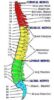

Overview of the nervous system
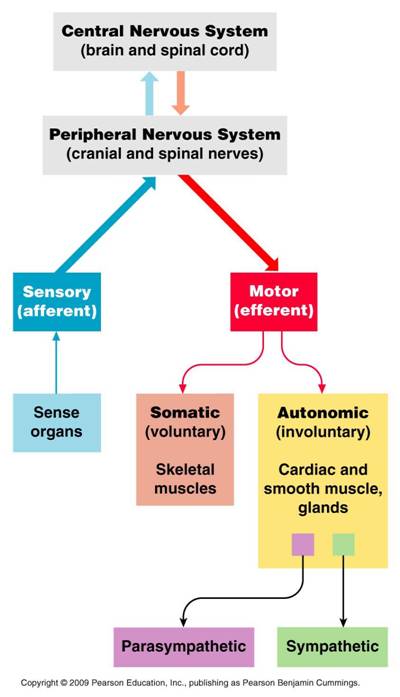
The nervous system is divided into two parts
(1) Central Nervous System (CNS) – Brain and spinal cord
(2) Peripheral Nervous System (PNS) – Cranial and spinal nerves.
Nerves pass messages to and from the CNS
Sensory (afferent) Neurons. Transmit impulses TO the CNS from the sense organs.
Motor (efferent) Neuron System. Transmits impulses FROM the CNS to effectors. Motor neurons act either by conscious decision or “behind the scenes”
a) Somatic (voluntary) Nervous System – directs contraction of skeletal muscles
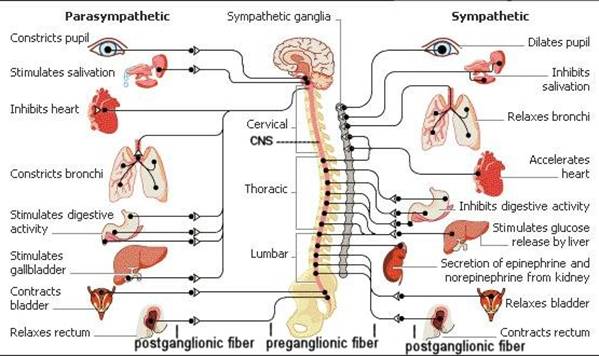
b) Autonomic (involuntary) Nervous System – controls activities of organs and various involuntary muscles, such as cardiac and smooth muscles. Has 2 systems that generally target the same organs but are antagonistic.
i. Parasympathetic Nervous System – “Rest and Digest” or “Brake” – activates tranquil functions. E.g. secretion of saliva or digestive enzymes.
ii. Sympathetic Nervous System – “Fight or Flight” or “Accelerator” – prepare body for action. E.g. increasing heart rate, increasing sugar release from liver to blood.

Peripheral Nervous System (PNS)
Unlike the CNS, the PNS is not protected by the bone of spine and skull, or by the blood-brain-barrier, leaving it exposed to toxins and mechanical injuries
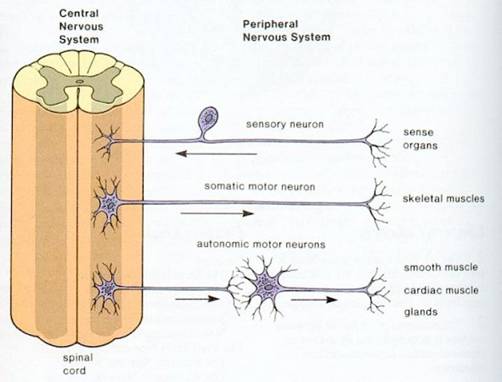
The PNS is comprised of nerves (neurons) that are either MOTOR or SENSORY
Which one is determined by direction of nerve impulses:
(i) Sensory/afferent neurons. Relay nerve impulses toward the central nervous system (CNS). E.g. A touch or painful stimulus creates a sensation in the brain after information about the stimulus travels through the spinal cord to the brain via afferent nerve pathways.
(ii) Motor /efferent neurons. Relay nerve impulses away from the CNS
PNS nerves are used for control of SOMATIC (Conscious/voluntary) or AUTONOMIC (Subconscious/involuntary) functions
(i) SOMATIC nervous system (SNS,Conscious/voluntary control). Includes all of the nerves that serve the skeletal muscles and the exterior sense organs and also includes reflexes. Connects skeletal muscles with cells specialized to respond to sensations, such as touch and pain.
(ii) AUTONOMIC nervous system (ANS,generally subconscious control)
Motor and sensory neurons connecting the CNS with internal organs (E.g. heart), smooth muscle, glands.
- SYMPATHETIC nervous system. Mobilizes energy and resources during times of stress and arousal
- PARASYMPATHETIC nervous system. Conserves energy and resources during relaxed states.
- ENTERIC nervous system. Neurons directly control the digestive tract, pancreas, and gallbladder.
Damage to peripheral nerves of SNS or ANS is called peripheral neuropathy, which can affect communication signals between body parts and the brain. This affects both sensory nerves (e.g. pain sensations), motor movemant (muscles) or involuntary controls for breathing, digestion, heart rate, blood pressure, bladder function etc
Anatomy of PNS
12 pairs of cranial nerves. Emerge directly from the brain, sensory nerves, motor nerves, or mixed nerves. All of them control the head, face, neck, and shoulders, except the vagus nerve, which controls the internal organs.
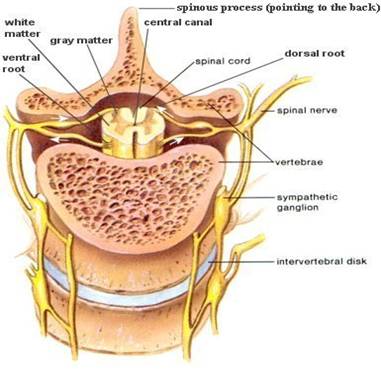
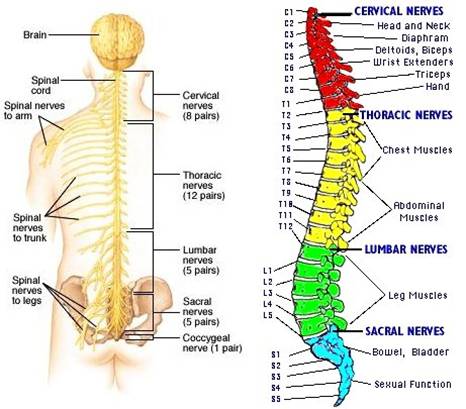
31 pairs of spinal nerves. Emerge from segments of the spinal cord; mixed nerves that take impulses to and from the spinal cord.
PNS cranial nerves
12 pairs of nerves connecting the brain to parts of the head, neck and trunk, each named for its function or structure. Categorized as sensory (for senses such as smell, hearing, touch) or motor nerves (control movement / function of muscles or glands).
I. Olfactory nerve – sends sensory information on smells to the brain
II Optic nerve – sensory vision from retinal rods (black/white, night vision) and cones (color information) sent to visual cortex in the back of the brain
III. Oculomotor nerve – brain sends eye socket muscle function (for focusing) and pupils (for light response)
IV. Trochlear nerve – brain controls superior oblique muscle in the eye sockets, responsible for downward, outward and inward eye movement
V. Trigeminal nerve – largest cranial nerve has 3 divisions
- Opthalamic: sends sensory information from upper face, including forehead, scalp, upper eyelids
- Maxillary: sends sensory information from cheeks, upper lips and nasal cavity
- Mandibular: sends sensory information from ears, lower lip and chin; controls muscle movement in jaw and ear
VI. Abducens nerve. Controls laterus rectus muscle in eye socket for outward eye movement
VII. Facial nerve.
- Moves muscles for facial expressions and some for jaw movement
- Sensory nerve for taste (most of tongue)
- Supplies head and neck glands e.g. salivary and tear-producing glands
- Sensory from outer parts of ear
VIII. Vestibulocochlear nerve. Specialized cells in cochlear of ear detect sound vibrations of loudness and pitch. Other special cells in vestibular area of ear track linear and rotational head movements for brain to correct balance and equilibrium.
IX. Glossopharyngeal nerve.
- Sends information from sinuses, back of throat, parts of inner ear and senses taste from back area of tongue
- Stimulates voluntary movement of muscle in the back of throat
X. Vagus nerve. This busy nerve:
- Senses / conveys information from ear canal, parts of throat, heart and intestines (and other chest / trunk organs), and a sense of taste rear root of tongue.
- Allows motor control of throat muscles, peristaltic movement through digestive tract, and stimulates other chest / trunk organs
XI. Accessory nerve. Controls neck muscles for rotating, flexing and extending neck and shoulders. Two parts: spinal and cranial.
XII. Hypoglossal nerve. Controls most tongue muscles