

Warts the matter?
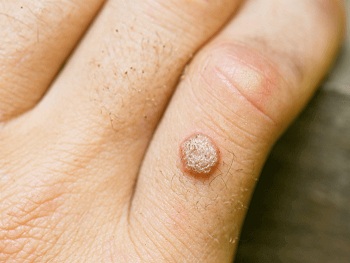

What exactly are these ugly looking things?
Small, rough growth on the skin resembling a cauliflower or solid blister
Typically on human hands or feet. Also other locations, such as genitals.
Warts are contagious – the virus usually entering via broken skin
Caused by one of the ~ 130 types of human papillomavirus (HPV). Only found in skin keratinocytes or mucus membranes (of the genitals). Each type is typically only able to infect a few specific areas on the body.
- Many low-risk types can produce a benign growth, often called a “wart” or “papilloma”, in the area they infect. HPV types 1,2, 3, 4, 26, 29, 57 and others.
- High-risk types can cause cancer. Cervical (mostly Types 16 and 18), and also vulvar, vaginal, penile, anal, some oropharyngeal cancers caused by types 58, 33, 45, 31, 52, 35, 39, 59, and others.
Typically disappear after a few months, But can stay for years or reoccur.
There are at least 10 varieties of warts
Here are some of the more well-known ones:
- Common wart (Verruca vulgaris) – a raised wart with roughened surface, most common on hands, but can grow anywhere on the body; HPV types 2 and 4 (most common);
- Flat wart (Verruca plana) – a small, smooth flattened wart, flesh-coloured, which can occur in large numbers; most common on the face, neck, hands, wrists and knees;
- Filiform or digitate wart – a thread- or finger-like wart, most common on the face, especially near the eyelids and lips;
- Genital wart (venereal wart, Condyloma acuminatum, Verruca acuminata) – a wart that occurs on the genitalia.
- Mosaic wart – a group of tightly clustered plantar-type warts, commonly on the hands or soles of the feet;
- Plantar wart (verruca, Verruca plantaris) – a hard sometimes painful lump, often with multiple specks in the center; usually only found on pressure points on the soles of the feet; Commonly HPV type 1;
- Periungual wart – a cauliflower-like cluster of warts that occurs around the nails.
How to remove cutaneous warts
Wart may regrow after it has been removed since they are caused by a virus, which can retreat to its dormant form.
Transdermal Ozone – powerful therapy to remove warts if you have an ozone generator. Apply ozone once/day (20-30 mins) for a week or two. Alternatively use ozonated olive oil.
Ozone Therapy
A review of 52 clinical trials of various cutaneous wart treatments concluded:
- Best supported topical treatments contained salicylic acid (available OTC, similar to active ingredient in aspirin: acetylsalicylic acid) – with average cure rate of 75%, compared with 48% for the placebo in six placebo-controlled trials including a total of 376 participants. Involves cleaning the area, applying the acid, and removing the dead skin with a pumice stone or emery board over time. Gibbs S, Harvey I, SterlingJC, Stark R (2003). Gibbs, Sam. ed. “Local treatments for cutaneous warts”. Cochrane Database Syst Rev (3): CD001781. doi:10.1002/14651858.CD001781. PMID12917913.
- Little evidence of a significant benefit of cryotherapy over salicylic acid or duct tape. Gibbs S, Harvey I, SterlingJC, Stark R (2003). Gibbs, Sam. ed. “Local treatments for cutaneous warts”. Cochrane Database Syst Rev (3): CD001781. doi:10.1002/14651858.CD001781. PMID12917913.