3 Family planning / Birth Control Alternatives - That do not cause harmful side-effects


FAMILY PLANNING:
(1) Fertility Monitor - "Family planning tool"
What is a fertility monitor and what is its purpose?
A fertility monitor (also called ovulation monitor, ovulation microscope, fertility microscope, saliva monitor, saliva microscope) is a device that alerts to impending or actual ovulation – The monitor requires samples of saliva, urine or cervical fluid to run the test. There are many different brands and types of fertility monitors with a cost ranging from around $40 to $400.
It is used for:
| • Trying to become pregnant | • To determine whether you’re ovulating |
| • Trying to avoid pregnancy | • To enhance awareness of your menstrual cycles |
The fertility monitor should be used around the days of the menstrual cycle when a woman can conceive:
- There are only about 3 days when her egg is available for fertilization
- Sperm can survive up to 72 hours (3 days) in the vagina and uterus – so if sexual intercourse occurs up to 3 days before a woman is fertile, she can still potentially become pregnant.
Thus, there are about 6 days per month that a woman can conceive (3 days prior to fertility, and 3 days of fertility).
Several tech-savvy fertility monitors can be found at a cost around $110 – $270. The following example is a simple but more affordable choice:
KNOWHEN® SALIVA Ovulation Microscope (hand-held mini-magnification lens)
The KNOWHEN Saliva ovulation microscope is about the size and shape of a lipstick holder and sells for about $38 (in 2026) on amazon.com. A simple tool to make it easy to examine saliva to check for crystalline patterns indicating hormonal changes.
| Pattern in Saliva just Prior to and During Fertile Days |
|---|
It is scientifically well established that hormones filter into saliva – and that: • Just Prior to and During fertility – a fern pattern can be seen in saliva under a high-powered magnification lens. • During non-fertile days –only random and shapeless dots will be visible. |
If you want to check whether you may be fertile, you simply:
- Make sure you haven’t smoked, taken medication or had anything to eat or drink for 2 hours – It is best to use it at the same time every day
- Using fingertip put a small amount of saliva on the slide – and allow it to dry ( 5-7 minutes)
- Insert the slide into the magnification lens and push a little button – to illuminate the sample.
If you are just about to become fertile or if you are fertile, you will easily see a beautiful crystalline fern pattern under the magnification lens (see below “Analysis of Saliva – Detection of Fertility”) – This is an easy and convenient way for you to monitor your hormonal changes and enhance your awareness of your menstrual cycle. If you track your cycles and fertility on a calendar, soon you will have a keen awareness of where you are in your monthly cycle, and what is happening hormonally in your body.
Identifies cycles when there has been no ovulation. Cycle awareness can be especially helpful for women who tend to have anovulatory cycles (no ovulation occurs and thus there is infertility, and no Progesterone is produced). If you know that you haven’t ovulated in any given cycle, and thus your ovary won’t be producing Progesterone, you can then supplement with Progesterone that month and avoid estrogen dominance symptoms such as PM
- The ovulation kits that measure hormones in urine to determine fertility tend to be expensive, messy, and can only be used once. In contrast, at the cost of not much more than one ovulation kit, the Ovu-Tec®can be used over and over, and has a lifetime manufacturer’s warranty.
| Analysis of Saliva – Detection of Fertility |
|---|
“Fern” structures start 3-4 days before ovulation and end 2-3 days after ovulation occurs – The fertile period lasts less than one week. In addition to clearly “dotted” or “fern” patterns, the saliva sample may appear to be a combination of the two images. This is called a “transition” pattern. During this period, it may be possible that the woman is fertile. If you do not become pregnant during the indicated periods and wish to become pregnant, it is recommended that you consult a physician. Refer to the following for interpretation of saliva specimens: |
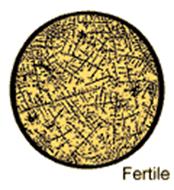

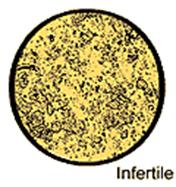
The TRANSITION period is the most difficult to determine – it will show a combination of dots and ferns. You are less fertile, but conception is still possible.
WARNING: The quality of saliva specimen may be affected by smoking, alcohol consumption, medications, or food consumption – Wait until 2 hours after smoking, eating, drinking or taking medications.

(2) The Temperature Method - "Family planning tool"
This method monitors body temperature, which increases after ovulation. Involves taking your basal body temperature (your temperature upon first waking) each morning with an accurate “basal” thermometer, and noting the rise in temperature that occurs after ovulation.
Being able to pinpoint the day of ovulation enables you to:
- – To avoid pregnancy. By avoiding sex for a few days before and after;
- – To have a better chance of getting pregnant. By having daily sex a few days before and after ovulation ;
Illness or lack of sleep can change your body temperature and make this method unreliable by itself. When it is combined with the mucus method, it can be an accurate way of assessing fertility. The two methods combined can have a success rate as high as 98 percent.
Lorem ipsum dolor sit amet, consectetur adipiscing elit. Ut elit tellus, luctus nec ullamcorper mattis, pulvinar dapibus leo.
(3) The Mucus Method - "Family planning tool"
Vaginal Discharge Changes during menstrual cycle |
|
| Situation | Discharge type |
| First few days after your period | Usually no discharge |
| As estrogen starts to rise | Cloudy, tacky mucus |
| Ovulation is near | Starts to increase in volume and becomes clear and stringy |
| Ovulation has passed | Return to tacky, cloudy mucus or no discharge |