

Food fats digestive journey
Some definitions
- Esterification. A chemical reaction between an alcohol and an acid.
- Emulsification. Process of mixing fats with water to help solubilize hydrophobic molecules – E.g. Phospholipids are emulsifiers.
- Lipolysis. Break down of fats.

Digestion of food lipids
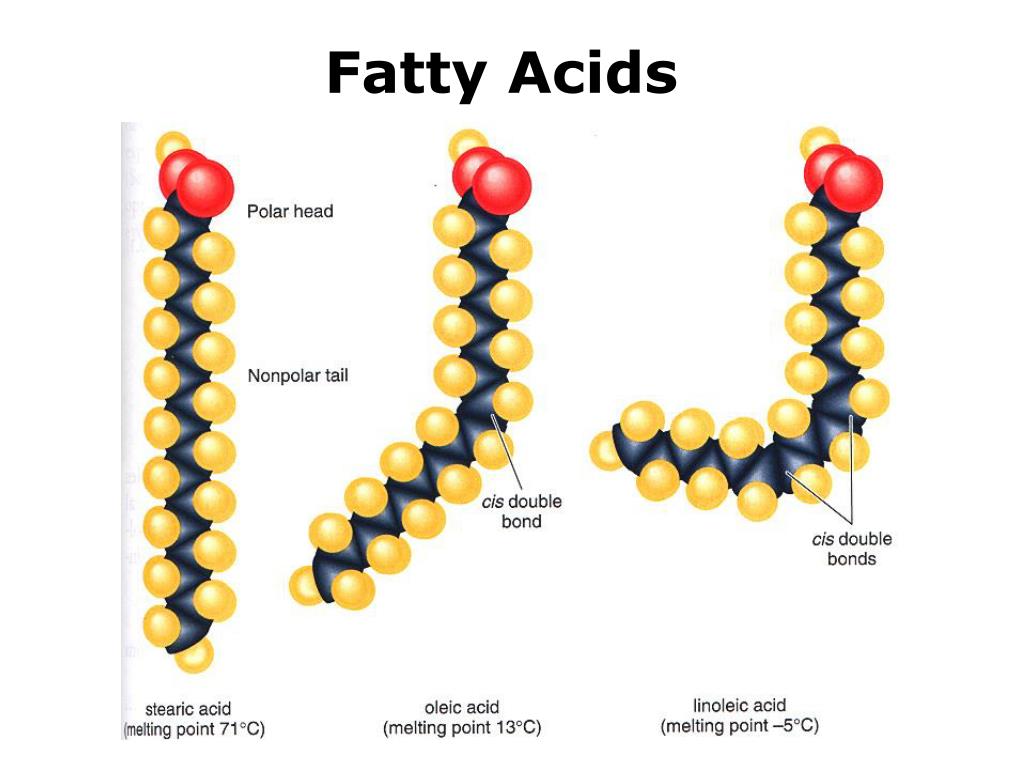
- 95% of dietary lipids are triglycerides (TGs). Glycerol esterified to 3 fatty acids; primary source of cellular energy production, or can be stored for later use. Contain more than twice the energy of carbohydrates or protein.
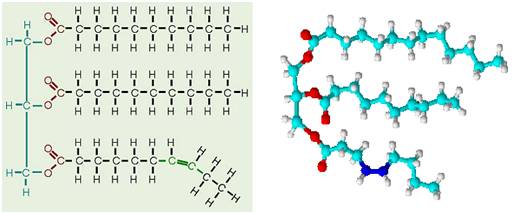
- Phospholipids (PLs). Glycerol esterified to two fatty acids and a phosphate group.
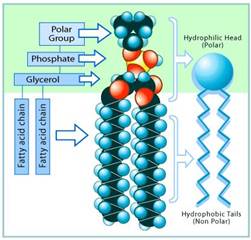
- Free fatty acids (FFAs)
- Esterified cholesterol (and other sterols). Food form of cholesterol is esterified
- Fat-soluble vitamins
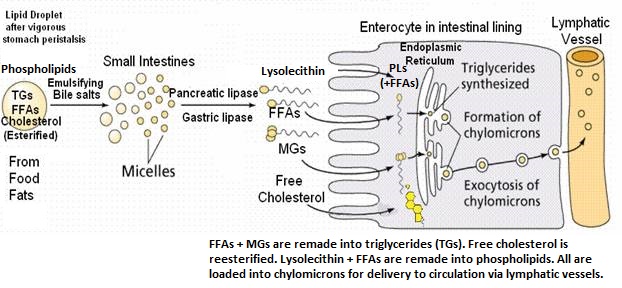
The Fat Journey - From food ==> fat cells, muscle cells and liver
Large water-insoluble fats must be transformed into a water-soluble form for their journey in the circulatory system to the liver
Stomach Peristalsis – after partial breakdown in the mouth by lingual lipase enzymes in saliva, all food fats are first vigorously churned in the stomach.
Emulsification / Micellarization – The insoluble lipid food globules are then emulsified and made smaller by the action of bile salts* in the small intestines. This results in bile-enveloped drops (micelles) with increased accessible surface area for further break down by the pancreatic enzymes. * Bile salts are made from cholesterol in the liver and stored in the gallbladder.
Fats are freed from their packages
- Fatty acids are split from triglycerides (Hydrolyzation). Pancreatic lipase enzymes catalyze the hydrolization of TGs into free fatty acids (FFAs) and monoglycerides (MGs):
TGs (triglycerides)➜ MGs (monoglycerides) and FFAs (free fatty acids)
( pancreatic lipase)
- Cholesterol De-esterified
Cholesterol esters are de-esterified ➜ free cholesterol
(Pancreatic cholesterol ester hydrolase)
- Fatty acids split from phospholipids
Phospholipids ➜ Phospholipid intermediates and FFAs
(Phospholipase A2)
MGs, FFAs, Free cholesterol shuttled to intestinal villi for absorption – Generally however, FFAs with < 14 carbons in their chain enter the liver directly via the portal vein. This is of value to those with (1) impaired bile secretion (e.g with biliary obstruction, liver diseases, gall-bladder removal) or (2) poor pancreatic lipase enzyme secretion (as in cystic fibrosis). Short/Medium-length carbon chain FFAs (E.g.in coconut oil and butter) are thus better utilized as energy sources in individuals with fat malabsorption.
MGs and FFAs are reassembled into TGs, and packaged together with cholesterol into chylomicrons – this takes place in the intestinal lining cells (enterocytes). Chylomicrons are the largest of the lipoproteins, whose purpose is to transport fat from food in the “watery” blood.
Chylomicrons transport dietary TGs and cholesterol – through the lymphatics into the circulation.
ADIPOSE and MUSCLE CELLS take up FREE FATTY ACIDS and GLYCEROL for energy use or storage – obtained by hydrolizing 90% of the TGs contained in the chylomicron.
CHOLESTEROL and the FAT-SOLUBLE VITAMINS (A, D, E, and K) are delivered directly to the LIVER in chylomicron remnants – where these remnants are cleared.
Metabolism of lipids inside the body
Primarily, the liver synthesizes TGs, cholesterol and their carriers (called lipoproteins) to transport them in the blood – These carriers circulate until their contents are taken up by peripheral tissue cells or the lipoprotein carrier itself is cleared by the liver. As they lose TGs, the lipoproteins become more cholesterol rich.
Cells can also produce cholesterol