

Fibromyalgia - Symptoms of a cause
What is fibromyalgia?
Called a syndrome, fibromyalgia is the second or third most common disorder treated by rheumatologists. Fibromyalgia symptoms of stiff and swollen joints, aching muscles and exhaustion are frequently seen in rheumatoid and psoriatic arthritis patients. Fibromyalgia has many symptoms in common with Chronic Fatigue Syndrome (CFS), and these two syndromes may turn out to be one and the same. Fibromyalgia is not considered to be an auto-immune disease.
Associated with low dopamine / Reduced gray matter in the brain. According to a study published in The Journal of Pain, fibromyalgia is linked with reduced gray matter, possibly resulting from low DOPAMINE production in the areas of the brain that process pain. Grey matter is a major part of the central nervous system (CNS) containing neurons and their dendrites (which receive signals from other cells) and other cell bodies, but few myelinated axons, compared to white matter which has few cell bodies and many axons. Grey matter plays an essential role in mental functions, emotions and movement
Who is more likely to have fibromyalgia?
- 9 times more common among women than men. Usually between the ages of 40 and 60
- More common in Caucasians than other races


Symptoms of fibromyalgia?
Fibromyalgia presents as one or more of several symptoms:
- Overactive Nerves
- PAIN In muscles, joints, tendons
- Fatigue
- Morning stiffness
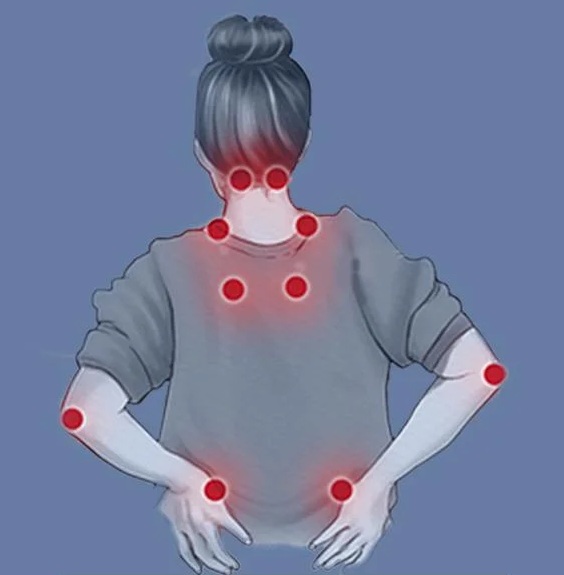
- Fibromyalgia trigger points. Tender areas, mostly on the back part of the body above the hips, that are ‘tender’ or painful when they are pushed or pressed. There are 18 tender point locations located where the ligament attaches the muscle to the bone. Sensitivity at 11 points defines a diagnosis of fibromyalgia.
- Difficulty Sleeping
- Migraine headaches
- Raynaud’s-like syndrome/ Numbness, tingling
- Brain Fog / Depression / Anxiety
- Irritable Bowel Syndrome (IBS)
Causes of fibromyalgia
Infection
Well documented connections exist between fibromyalgia and several infections:
- Mycoplasma GL Nicholson, NL Nicholson, Diagnosis and Treatment of Mycoplasmal Infections in Persian Gulf War Illness – CFIDS patients, Int. J Occup Med Immunol Tox 1996; 5: 69-78.
- Chlamydia pneumoniae. Antibodies to Chlamydia pneumoniae have been found in 78.3% of rheumatic patients with FM or 67.4% for unselected rheumatic patients tested. I Machtey, Chlamydia pneumoniae antibodies in Myalgia of Unknown Cause (including Fibromyalgia)
- Hepatitis C. A Spanish study found 15% of 112 FM patients had Hepatitis C viral Infection (HCV). Rivera J, De Degio A, Trinchet M, MonforteAG, Fibromyalgia-associated Hepatitis C Virus Infection, Br J Rheum, 1997;
- Parvovirus B19. 30-60% of the general population test positive for Parvovirus B19, which incidence increases with age. AM Berg, SJ Naides, RW Simms, Established Fibromyalgia Syndrome and Parvovirus B19 Infection, J Rhu, 1993; 20: 1941-1943.
- HIV. Up to 25% of HIV patients have fibromyalgia symptoms. D Buskila, DD Gladman, P Langevitz, S Urowitz, HA Smythe, Fibromyalgia in Human Immunodeficiency Virus Infection, J Rhu, 1990; 17:9, 1202-1206.
- Epstein-Barr. D Buchwald, DL Goldenberg, JL Sullivan, AL Komaroff, The “Chronic Active Epstein-Barr Virus Infection” Symdrome and Primary Fibromyalgia, Arth & Rhu, 1987; 30:10, 1132-1136.
The following infections are zoonotic (i.e. can be transmitted between wild or domestic animals and humans). Of the 1,415 pathogens known to affect humans, 61% are zoonotic – usually from ticks, but also fleas, lice, and mites. According to Dr. Hines, a naturopathic doctor, master herbalist and endocrinologist, 70% of his patients with fibromyalgia or CFS had one or more of the following zoonotic infections:
- Lymes disease. Caused by the spirochete Borrelia Burgdorferi, which is a microphile. i.e. requires low-level oxygen; 25-40% of long-term Lyme’s disease patients develop fibromyalgia-like symptoms.
- Leptospira. Another disease caused by spirochetes, possibly the most common zoonotic infection worldwide
- Babesiosis. Commonly coexists with Lyme’s Disease, caused by the blood parasite Babesia, of which there are over 100 species. Disease typically occurs in cattle, dogs, horses, sheep and swine.
- Rocky Mountain Spotted Fever. An infection caused by Rickettsia rickettsii. A bacterium found in fleas, ticks, lice, and mites, transmitted by bite to vertebrate hosts, including humans. It is characterized by high fever, pains in joints, bones, and muscles, and a skin eruption. First reported in the Rocky Mountain area, but now widely spread throughout the U.S. The R. rickettsii infection is the most lethal and most frequently reported rickettsial illness in the U.S.
- Cat Scratch Fever. Caused by a viral infection resulting from the scratch or bite of a cat. It is characterized by fever and swelling of the lymph nodes.
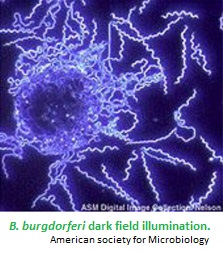
More on spirochetes. “After entering the body through a tick bite, spirochetes burrow into the muscles where they take up residence. Spirochetes are difficult to diagnose since they are not in the blood.
- Spirochete bacteria are very resilient and can adapt to resist attack. The spirochete can take a cyst form, untouchable by most antibiotics. It also hides in the joints of the body, in areas of poor circulation, and possibly within immune system cells. Long-term antibiotic use has shown some success against fibromyalgia, but not without the antibiotics creating their own set of problems, including kidney and liver damage, and gallbladder and other digestive problems.
- Living in a community, it multiplies and poops producing toxins in muscles and joints. These toxins are attacked by the immune system, which leads to chronic inflammation and pain, with accompanying destruction of muscles and joints.
Malabsorption problems
Chronic stress is #1 initiator of malabsorption. Acute stress necessarily shuts down GI tract function to divert all energy to the muscles in the ‘fight or flight’ response. However, chronic stress intereferes with necessary GI function, and leads to inflammation and decreased stomach acid production. This in turn can cause increased intestinal permeability, which leads to problems such as:
- Gluten Sensitivity / Other food allergies
- Nutrient Deficiencies. Especially of Vitamin B12
- Autoimmune Diseases
- Stomach Infections. E.g. H Pylori Bacteria and Intestinal Candida
Some common nutrient deficiencies cause pain
Magnesium Deficiency. Muscle spasms can be partly attributed to a severe magnesium deficiency -a common problem for many people. The microspasms that occur in Fibromyalgia are so severe that some researchers refer to them as ‘Tetany’. The constant muscle spasming not only causes pain, but uses up the muscle energy stores making your muscles feel weak. Stress plays a major role in depleting the body’s magnesium. Be aware that blood tests for magnesium are not helpful in determining magnesium status.
Magnesium – Missing Miracle Mineral
Vitamin D Deficiency. Can be partly responsible for pain, since it can cause osteomalacia by preventing calcium absorption into the bones. As bone cells lose calcium, the ensuing bone demineralization leads to osteoporosis. A ‘gelatin-like’ substance inside bones becomes more porous, absorbing water, and as it expands, it pushes on the thin living layer covering the bone, called the perosteum. The many nerve fibers running through the perosteum respond by what we feel as pain, sometimes widespread all-over body pain.
Vitamin D -The Sunshine Vitamin
B-12 Deficiency. B12 is needed to build myelin, and its deficiency can cause myelin sheath damage affecting neural transmission of pain, seen in fibromyalgia, M.S., and peripheral neuropathies
- A vitamin B12 deficiency can present as:
Soreness and weakness in legs and arms
Pain – including back pain
Mental symptoms / illness – including depression, dementia , Alzheimer’s. “Brain Fog”
M.S. and other degenerative neural disease
Infertility – can effect ovulation, cause recurrent miscarriage and reduce male infertility PubMed, PubMed
Blood disorders – E.g. Macrocytic anemia
- Possible causes of a B12 deficiency, include:
Being vegan. Since animal products are the only significant B12 source and even though the liver stores up to 3 years of the small amounts of B12 obtained from vegetables, it may stil not be enough.
H. Pylori infection. Responsible for stomach ulcers, it can also cause increased intestinal permeability, resulting in B12 (and vitamin D ) malabsorption
Low stomach acid. The real problem for those with heartburn; also responsible for H. Pylori infection
Intestinal by-pass surgery. Commonly a cause of B12 (and Vitamin D) malabsorption /deficiency
B12-depleting drugs, include:
Nitrous oxide. “Laughing Gas”used for anaesthesia at the dentist.
Metformin . Sommon diabetic drug
Nipride. Used in ICU
Lack of intrinsic factor. Needed for B12 absorption. Although possible, the other causes listed are more likely culprits.
Oxidative stress
Oxidative stress produces reactive oxygen species (ROS) (free radicals. Can cause inflammation and tissue damage.
Oxidative stress can originate from many sources. Including toxin overload, emotional stress, too much sugar, damaged fats and much more
Where do the body’s ROS Come from?
The antidote to oxidative stress. Eliminate its source or counter it with antioxidants
Mitochondrial dysfunction
Lowered cellular energy production is involved with fibromyalgia. Crucial nutrients used by the cell’s mitochondria to produce energy include:
Hypothyroid condition ?
Fibromyalgia (and Chronic Fatigue Syndrome) may be a manifestation of a hypothyroid condition
Adrenal gland fatigue
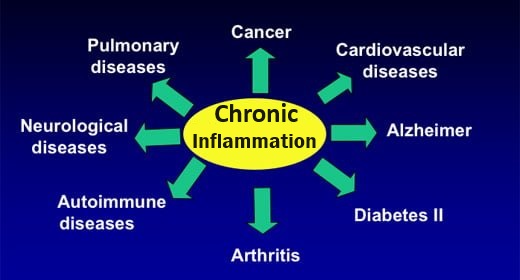
Adrenal gland fatigue is a well-researched component of fibromyalgia. Several stressors can wear out the adrenals to the point of you feeling exhausted. However, chronic inflammation, a symptom of fibromyalgia, may well be initiating the adrenal fatigue, rather than some other stressor.
Fibromyalgia may also stem from adrenal glands that are smaller than average – according to some studies. Ref?
Treatment options for fibromyalgia
Magnesium
Use magnesium “oil” transdermally over painful areas. This therapy is enhanced by combining with 70-90% DMSO gel (99.99% pure). DMSO is used to drive the magnesium more effectively into body tissues
Transdermal Magnesium Chloride
DMSO – Medicine Carrier / Cell membrane penetrant
DMSO
DMSO is used to carry other medicines into the body but in its own right can relax blood vessels, improve circulation, and restore neural connections. DMSO has the ability to penetrate skin, tissue cell and cell membranes to enter muscles. organs, bones and the brain whether used transdermally or orally.
DMSO – Medicine Carrier / Cell membrane penetrant
Manage Stressors
Balance your adrenal glands
Balance your adrenal glands – “Stress Management Glands”
Iodine
Take Iodine to counter a possible hypothyroid condition. Iodine is typically under-supplied in the West, given our current diet and environmental conditions
Iodine – For much more than making thyroid hormones
5-HTP
5-HTP is a precursor for SEROTONIN and MELATONIN. These alleviate pain and aid sleep – both symptoms of fibromyalgia.
Antioxidants
Antioxidants for fibromyalgia patients include:
- Lipoic Acid
- Selenium
- Ubiquinol (CoQ10)
- Vitamin C
Food / Supplemental antioxidants
Anti-inflammatory fats
Detoxify the body / Energize your cells using electrotherapy
The Beck Protocol is probably the simplest, generally affordable method to detoxify the body available to us today. Electrotherapy provides the ONLY method of reaching microbes, such as spirochetes, that have burrowed into tissue. Microcurrents and electromagnetic pulses produced by 2 small devices are used non-invasively on and near the body to detoxify the blood, lymph and organs of microbial infection. One of the machines can also be used to make ionic colloidal silver to further aid the detoxification process. Most testimonials report improvements after about 3 weeks and complete success after a couple of months of applying the Beck Protocol
PEMF therapy. Not cheap but has had some good feedback for fibromyalgia. E.g. using the iMRS or Bemer units.
RIFE THERAPY. Another effective electrotherapy, but more expensive than the Beck Protocol
Rife Resonance Frequency Protocol
VITAMIN B12
Take B12 (Methylcobalamin) supplement
NIR class 4 laser therapy
NIR class 4 laser therapy is an effective healing frequency therapy in the infrared range (~700-1000 nanometers) obtainable at reasonable cost at clinics throughout the U.S. Not only stops the pain, but also affects a cure:
- Reduces pain
- Reduces inflammation
- Enhances tissue healing
Low Dose Naltrexone (LDN)
“Off-label” use of the drug Naltrexone has been showing great promise in the treatment of autoimmune diseases when administered in non-customary low doses. Although not considered to be an autoimmune disease, fibromyalgia has many symptoms in common with autoimmune disease, and LDN has been found effective in reducing fibromyalgia symptoms
Low Dose Naltrexone (LDN) – Immune regulator for Auto-Immune Diseases