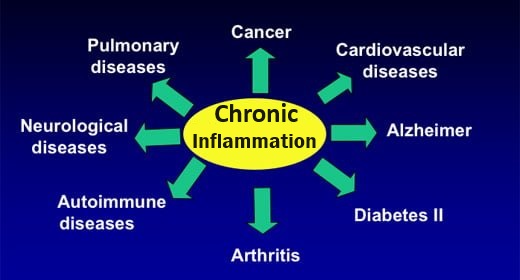







Ischaemic Cardiovascular Disease (CVD) - Chronic inflammation response to damaged arterial walls (cholesterol is not the problem)
Cardiovascular disease (CVD) is currently the leading cause of death in the United States, Canada and England.


- CARDIOVASCULAR DISEASE (CVD): About
- Types
- Causes
-
-
-
CVD is an inflammatory response to damage – So what injures the arterial lining?
- Mechanical / Hemodynamic stress
- Oxidant / Antioxidant Imblance
- Hyperglycemia (high blood sugar) increases damaging AGEs
- Elevated levels of Homocysteine
- Acid-forming diet
CVD / Atherosclerosis is a consequence of weakened walls due to a chronic vitamin C deficiency
Cholesterol and saturated fat are not the “Darth Vader” of heart disease
-
-
-
- Atherosclerosis
-
- ♪How can you mend a broken heart?♫
- $tatins – Don’t save lives!
-
"CVD" typically refers to an ischaemic cardiovascular disease
Ischaemia is a restriction of BLOOD SUPPLY to body tissues, which reduces oxygen delivery for cellular metabolism to keep them alive
Overview
Ischaemic CVD is a chronic inflammatory response to ongoing damage to arterial walls weakened by a chronic vitamin C deficiency. To prevent you from bleeding to death, your body places what is supposed to be a temporary patch (called plaque) over the damaged area, to “buy you time” to deal with what is causing the problem. However, if those causes are not addressed, the growing plaque narrows the opening of the artery restricting blood flow delivering oxygen to the heart muscle, brain and other vital organs.
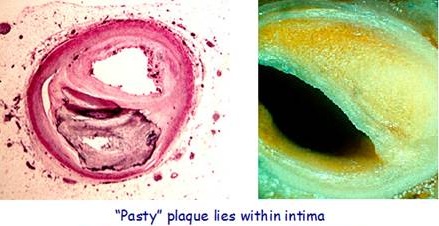
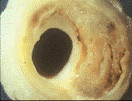
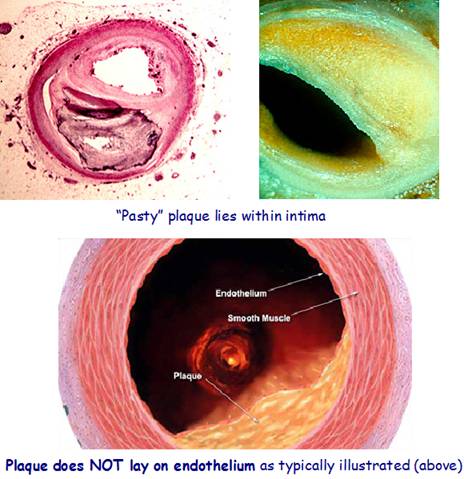
Ischemic CVD is present when arteries are at least partially blocked with the repair “plaque” laid down within the arterial wall (the intima, between the arterial lining and smooth muscle) in response to damage (a lesion) at that location. The blockage narrows the arterial lumen increasing blood pressure and reducing the flow of oxygen-carrying blood (called ischemia) to the heart, brain (and other organs), which increases the risk of having some type of CVD or other target organ damage. Also, if the arterial plaque’s fibrous cap ruptures, the released plaque contents themselves can cause an obstruction, or else lead to the formation of a blood clot (thrombus), of which a small piece typically breaks off that can also cause obstruction by traveling in the bloodstream and can cause a heart attack by blocking one of the coronary arteries supplying oxygenated blood to the heart, or a stroke by blocking the carotid artery supplying the brain, both of which can be fatal. If the necessary oxygen doesn’t arrive then the tissue or organ will die.
Let’s talk about plaque
Note that atherosclerotic, cholesterol-containing plaque is NOT the cause of CVD, but rather your body’s attempt to save your life! Contrary to what you have been “sold”, neither cholesterol, nor saturated fat, have been proven to cause CVD or atherosclerosis.
Cholesterol and saturated fat are not the “Darth Vader” of heart disease
Plaque contains:
- Lipid core (approx. 30% of plaque) – Cholesterol esters (largest component), LDL cholesterol, free cholesterol, oxidized cholesterol, cell membrane lipids, some triglycerides. Cholesterol is ~20% of total plaque mass
- Foam cells. Macrophages that have engulfed oxidized LDL
- Inflammatory immune cells. Macrophages, T lymphocytes
- Smooth muscles cells. Help form fibrous cap
- Necrotic lipid core. Dead foam cells and smooth muscle cells, cholesterol crystals, cell debris, lipids.
- Calcium. Calcify older plaques
Lipoprotein(a). An oxidized LDL-cholesterol variant, called Lp(a), is highly atherogenic because it delivers oxidized phospholipids, promotes inflammation, and interferes with normal clot breakdown. Lp(a) is instrumental in forming plaque but is not one of its significant structural components.
Lp(a) – The Repairman in atherosclerosis
We have been deceived into believing that the culprits in CVD are high blood cholesterol and/or triglycerides — this is not so . . .
Cholesterol and Saturated fat are not the Darth Vader of CVD
Note that blood vessels can also constrict under certain stimuli and reduce blood flow – such stimuli include stress / anxiety, exposure to cold and NSAID‘s.
Two relevant questions
To remove the offending arterial plaque requires an understanding of what is causing it.
- What damages the arterial lining?
- What may be causing the arterial walls to be weak? Arterial wall integrity is provided by collagen, which requires a sufficient daily supply of vitamin C. Consequently, a long-term, low-level vitamin C deficiency will weaken the arterial walls.
Well-known ischaemic CVDs
- Coronary heart disease (CHD) / Coronary artery disease (CAD)
- Chronic high blood pressure (HBP)
- Heart attack (myocardial infarction)
- Angina
- Arrhythmia
- Stroke
- Thrombosis / Embolism
- Heart or Kidney Failure
What is going on with each of these cardiovascular diseases?

Statistics on heart disease deaths in the U.S.
- Heart disease kills one person every 33 seconds in the U.S. alone
- In 2022, 1 of every 5 deaths was from heart disease – that’s 702,880 people! And 1 in 5 of those deaths was in those under 65 years old.
- More than half of heart diease deaths were from coronary heart diease (CAD), which is present in 5% of adults over 20 years old.
- Black non-Hispanics have the highest percentage of deaths at 22.6%, Hispanics the lowest at 11.9%, and white non-Hispanics 18%. 2021 data
Various other diseases associated with the heart
Congestive heart failure. Condition resulting from any structural or functional cardiac disorder that impairs the ability of the heart to fill with or pump a sufficient amount of blood throughout the body;
Hypertensive heart disease. Caused by high blood pressure, especially localized high blood pressure. Conditions that can be caused by hypertensive heart disease include: Left ventricular hypertrophy, Coronary heart disease, (Congestive) heart failure, Hypertensive cardiomyopathy, Cardiac arrhythmias;
Inflammatory heart disease. Involves inflammation of the heart muscle and/or the tissue surrounding it;
Valvular heart disease. Any disease process involving one or more valves of the heart;
Cardiomyopathy. Disease of the heart muscle