Prostate cancer (PC)

PROSTATE CANCER:
THIS PAGE UNDER CONSTRUCTION
Overview
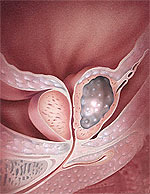
Prostate gland anatomy
The prostate gland. The purpose of the prostate gland is to produce fluid to nourish sperm and stimulate their motility. Prostatic fluid makes up about 1/3 of semen.
What is prostate cancer?
Prostate cancer is usually a slow-growing carcinoma (cancer of epithelium / lining) in the prostate gland. Cancer typically forms in the prostate’s glandular tissue, doubling in size every 4-5 years, but sometimes it is in the prostate muscle and connective tissue. Initially cancer cells are confined to the prostate, present no symptoms and cause no harm, but in time they can metastasize (usually to bones or lymph nodes), at which time symptoms present and the risk of dying is significantly increased. That said, a man may have PC without even being aware of it – and in fact, almost 80% of men over 80 yrs who die of other causes have PC.
Some types of PC can be more aggressive – presenting symptoms earlier than usual that may require treatment.
Prostate enlargement (Benign Prostate Hyperplasia or BPH – a major cause of problems in older men) may be associated with prostate cancer.
Key statistics about prostate cancer
Prostate cancer is the second-most commonly diagnosed cancer in American men (after skin cancer)
- 1 man in 7 will be diagnosed with prostate cancer during his lifetime – about 220,800 new cases in U.S. in 2015 (American Cancer Society data)
- Prostate cancer is the second leading cause of cancer DEATH in American men – lung cancer is #1;
- About 1 man in 38 will die of prostate cancer – About 27,540 deaths in U.S. in 2015 (American Cancer Society data)
Probability of getting prostate cancer increases with age – mostly affecting males over age 50. About 6 out of 10 cases diagnosed are in men aged 65 or older, and it is rare before age 40. The average age at the time of diagnosis is about 66.
Prostate cancer incidence and mortality rates are significantly higher in the Western world compared to Asian populations – suggesting a possible dietary / environmental link. (statistics are age-standardized to give a better comparison since PC is predominant in older men).
- In 2022, PC incidence rate of prostate cancer in U.S., UK, EU and Australia was ~75-80 per 100,000 compared to ~10 per 100,000 in China.
- In 2022 in the U.S. there was a 9.7% risk of prostate cancer at age 74, compared to 1.1% in China. Prostate Cancer Rates by Country 2025
- In 2022, the death rate for prostate cancer was 8.1 per 100,000 in the U.S., compared to 3.3 per 100,000 in China. The UK was 11.8 per 100,000 and Nigeria was 27.9 per 100,000! Prostate cancer statistics | World Cancer Research Fund
Prostate cancer detection
Usually detected by a high Prostate Specific Antigen (PSA) count (although there are other tests more indicative of prostate cancer and its progress) – the PSA count is higher when the immune system is dealing with a prostate problem. A slightly raised PSA count could simply be due to an infection / inflammation of the prostate. A normal PSA level is less than 4 ng / mL of blood. 4-10 ng / mL suggests possible BPH or prostate cancer (in 25% of men), over 10 ng / mL is associated with prostate cancer (in 50% of men). Men in their 50’s or younger typically have a PSA around 2.5 ng / mL. PSA readings have no upper limit and can reach 10,000 ng / mL or more.
Ultra-scans and prostate biopsies. Cancer tumors are typically found here and there throughout the prostate, and not as a single prostate cancer mass.

Prostate cancer symptoms
Overlapping symptoms of prostate enlargement (benign prostate hyperplasia / BPH) and prostate cancer sometimes make it difficult to distinguish between the two:
- Urgent need to urinate
- Excessive urge to urinate throughout the day
- Difficulty urinating or the need to force out urine
- Weak urination or dribbles
- Urine flow that stops and starts
- Feeling like your bladder never fully empties
However, there are some distinct symptoms signifying prostate cancer vs. benign prostate hyperplasia (BPH / Enlarged prostate):
- Burning when urinating
- Painful ejaculation
- Blood in urine or semen
- Erectile dysfunction
- Lower amounts of ejaculate
- Pelvic area discomfort
- Infertility
Prostate cancer causes
General factors
Age. Your risk of prostate cancer increases as you age.
Obesity. Waist circumference / belly fat increases your risk of dying early. Each 4 in.of waist size increases the chance of developing fatal PC by 18% and a premature death from any cause by 11%., according to an Oxford university study (published in 2020) involving 140,000 men, mean age 52 years, across 8 countries. The study also found that obesity increased the risk of getting a high-grade (aggressive form) of PC by 13%. University of Oxford Study published in the British Medical Journal, 2020

What measures can I take to prevent prostate cancer?
Vitamin D / Sunshine is the #1 cancer fighter
- Cheap and natural solution
- This steroid hormone has receptors in and influences almost all body cells. Once converted to its active form (Calcitriol) in the liver, kidneys and other tissues, your organs use it to repair damage and reduce cancer cells.
- Increases self-destruction of mutated cells. Prevents their replication; cancer cells usually begin as mutations.
- Shown to shrivel up cancer cells in days. Vitamin D and Cancer: JoEllen Welsh, State University of New York at Albany
- Reduces spread/reproduction of cancer cells.
- Causes cell differentiation. Cancer cells often lack differentiation, whereby a cell becomes more specialized by changes (mainly due to modifications in gene expression) in shape, size, membrane potential, metabolic activity and signal responsiveness.
- Reduces new blood vessel growth from existing ones. Angiogenesis is a step in the transition of dormant tumors becoming cancerous.
- Ideal level circulating CALCIDIOL (25(OH)D) is 65 – 90 ng/ml
- Synergistic with other cancer treatments
- Prevents many cancer deaths. One landmark study examining just breast and colorectal cancer deaths, determined that increasing vitamin D could prevent 600,000 deaths each year.
- Vitamin D is effective against at least 16 cancer types
- Found to work well as an adjuvant with Tamoxifen. Dr.Zheng et al, 2018
Emotional control
- Address stress. E.g. Using Meridian Tapping Technique (MTT) or SOTA Brain Tuner.
- Work on positive attitude
Iodine
Supplement with Iodine. Prevents cancer formation and spread, especially reproductive organ cancers.
Eat nutritional food
- Don’t eat processed / refined foods;
- Antioxidants. Especially vitamins A, C, E, and ubiquinol (active form of CoQ10); antioxidants control radical damage implicated in cancer; fight microbial imbalance;
- Omega – 3. E.g. as krill oil or wild salmon oil) shown to influence BRCA1 and BRCA2 genes against cancer;
- Eat broccoli or broccoli sprouts;
Regular moderate physical exercise
Take a daily 20-30 minute brisk walk
Reduce body’s estrogen levels
There are several tactics you can use to reduce estrogen in the body:
How to reduce body’s estrogen levels
For example:
- Maintain a healthy body weight. Estrogen hormone is produced in fat tissue and may trigger breast cancer.
- I3C / DIM. Phytochemicals such as indole-3-carbinol (I3C) and sulforaphane are components of cruciferous vegetables which exhibit antitumorigenic activity associated with altered carcinogen metabolism and detoxification. Diindolylmethane (DIM) is a major metabolite of I3C formed in the gut and represents a new class of antiestrogens that inhibit breast cancer growth. It also encourages cells that are abnormally multiplying to stop reproducing and die.
Researchers have found that DIM and genistein (a major isoflavone in soy) reduce production of two proteins whose chemotactic attraction to each other is necessary for the spread of breast and ovarian cancers. When applying purified versions of DIM and genistein to motile cancer cells, the researchers could literally watch these cells come to a near halt. When either compound was applied, migration and invasion were substantially reduced. Both DIM and genistein are already being developed for use as a preventive and a chemotherapy treatment for breast cancer, although more extensive toxicological studies are necessary as at the time of writing (2007).
DIM – Estrogen – blocker with anti – cancer benefits
Miscellaneous
- Limit alcohol to one or two drinks a day
- Improve INSULIN receptor sensitivity. Exercise and control intake of refined carbs and sugar; iodine also helps improve receptor sensitivity.
Causes / Risks of prostate cancer
Hereditary factors
Race.
- For reasons not yet determined, black men carry a greater risk of prostate cancer than do men of other races. Black / non-Hispanic men rates per 100, 000 men reported 176 incidences / 38 deaths, white non-Hispanic men 105 incidences / 18 deaths. In black men, prostate cancer is also more likely to be aggressive or advanced.
- Asian societies have a lower incidence of invasive prostate cancer. Also, associated mortality is lower than in Western society
Family history. If men in your family have had prostate cancer, your risk may be increased. Also, if you have a family history of genes that increase the risk of breast cancer (BRCA1 or BRCA2) or a very strong family history of breast cancer, your risk of prostate cancer may be higher. Familial prostate cancer occurs in about 10% of cases – occurring at an earlier age than non- familal prostate cancer. World Health Organization: Cancers of the male reproductive tract. In World Cancer Report, Stewart BW and Kleihues P (eds). Lyon, France: IARC Press, 2003, pp 208- 211.
Dietary factors
Vitamin K2 deficiency
Fat intake. Urinary concentrations of androgens and estrogens decreased in a group of white and black men who had decreased their dietary fat intake.74
Magnesium Deficiency / Calcium Excess
- Calcium and magnesium are opposites in their effects on our body structure. As a general rule, the more rigid and inflexible our body structure is, the less calcium and the more magnesium we need.
- High calcium supplements increase PC risk. A 1998 Harvard’s Health Professionals follow-up study of 47,750 men found those consuming between 1,500 and 1,999 mg of calcium supplements per day had about double the risk of being diagnosed with metastatic prostate cancer as those getting 500 mg per day or less. And those taking in 2,000 mg or more had over four times the risk of developing metastatic prostate cancer as those taking in less than 500 mg. The Harvard scientists speculated that the problem is a relative lack of active vitamin D (CALCITRIOL), rather than the calcium itself. A prospective study of calcium intake and incident and fatal prostate cancer, Feb 2006
- High intake of protein or calcium from dairy products associated with an increased risk of PC . An increase of 35g / day of dairy protein (milk products, cheese, yogurt) is associated with a 32% increased risk of PC. Calcium from from dairy products was also associated with higher PC risk, but not from other foods. Univ. of Oxford study published 2008 in BJ of Cancer.,
- Systematic review of studies suggest a link between prostate cancer and milk consumption. Sargsyan A, Dubasi HB. Milk Consumption and Prostate Cancer: A Systematic Review. World J Mens Health. 2021 Jul;39(3):419-428. doi: 10.5534/wjmh.200051. Epub 2020 Jul 27. PMID: 32777868; PMCID: PMC8255404. PubMed
Sex hormone imbalance
Sex hormones have a significant role in PC initiation and promotion
The following hormones have interactive roles in prostate cancer:
- Testosterone
- DHT
- Estradiol
- Progesterone
Mainstream medicine focuses on high level testosterone as the main culprit in PC. However, there is a lack of credible evidence from many studies looking for a correlation between testosterone levels and PC occurrence. testosterone were the cause of prostate cancer, we’d see 19 and 20 year old males (with their raging testosterone levels) developing PC. and it is typically a disease seen in older men. That said, testosterone must also be present for prostate cancer to occur. deprivation treatment (ADT) decreases life expectancy by causing heart disease:
DHT is more the problem than testosterone
Males produce progesterone (~ 1/2 the amount of women) which prevents the body’s conversion of testosterone to DHT by inhibiting the enzyme 5-alpha reductase (as effectively as the drugs Proscar and Saw Palmetto).
Estradiol increases cell proliferation, progesterone decreases it
Dr. John R. Lee (a pioneer of natural hormone therapy) hypothesized that estrogen dominance over testosterone is a more probable cause than high testosterone levels – referencing estrogen dominance as the only known cause of uterine cancer (where, in women, estrogen is dominant over progesterone), he mentions that both the uterus and prostate develop from the same embryonic cells, and both contain the oncogene bcl2 (B-cell lymphoma 2), and the cancer protective gene p53. Breast cancer cells do not multiply when women are on progesterone – which also reverses cancer of the ovary and uterus and small cell lung cancer (normally having a dismal diagnosis).
Cancer-protective p53 and cancer-promoting bcl2 genes
To summarize – In men, if the estradiol to testosterone ratio changes to cause a dominance of estradiol, prostate cancer cells can develop. However, testosterone must also be present for prostate cancer to occur. Progesterone supplementation is an obvious treatment for men with testosterone deficiency relative to their estradiol levels.
- Men make estradiol, although in much lower amounts than women.
- Study examined local aromatase enzyme expression and estrogen biosynthesis in the human prostate and demonstrated local estrogen biosynthesis in prostate malignancy, via prostate-induced aromatase gene expression. Also, the study showed potential alteration of aromatase promoter use with progression of disease. In NON- malignant prostate tissues, aromatase mRNA expression was absent from epithelium, but did localize to stroma. Ellem SJ et al, Local Aromatase Expression in Human Prostate Is Altered in Malignancy, 2004, J Clin Endocrinol Metab 89: 2434- 2441.
- A high level of estrogen metabolite 4- hydroxyestrone (4- OHE1) in a man’s body might increase his risk of developing prostate cancer – one conclusion from a 2010 study offers another novel finding . . . that high levels of estrogen metabolites (16- KE2 and 17- epiE3), considered fuel for breast cancer, might offer a protective benefit against prostate cancer – The relative amounts of the 15 estrogens and estrogen metabolites in the urine of prostate cancer cases were similar to that of non-cancer patients with the exception of the following estrogen metabolites: (a) 4- OHE1 were more abundant in men WITH prostate cancer and (b) 16- KE2 and 17- epiE3 were more abundant in those WITHOUT prostate cancer ScienceDaily, Apr. 22, 2010
- Higher levels of estradiol have been found in men who have enlarged prostate glands
- Estrogen and androgens must BOTH be present to produce cancer in the prostate (according to a study using mice). Androgens (e.g. testosterone, DHT) must be present, but are not necessarily the cause of prostate cancer; the study demonstrated:
- Estrogen (without androgens) showed direct proliferative response, characterized by discrete lobe-specific changes including smooth-muscle regression, fibroblast proliferation, inflammation, and basal epithelial cell proliferation and metaplasia.
- Lifetime exposure to elevated androgens exposure developed prostatic hyperplasia, but neomalignant changes in prostate.
- Combined androgen and estrogen treatment has been shown to induce BOTH prostatic dysplasia (development of abnormal cells) and prostate cancer (adenocarcinoma). G P Risbridger, J J Bianco, S J Ellem and S J McPherson, Oestrogens and prostate cancer, Endocrine- Related Cancer (2003) 10 187- 191 PubMed
How to treat prostate cancer
+ (1) Cancer Treatment Core

Of special mention
Baking soda / Maple Syrup Protocol. Baking soda alkalizes cells. Researchers have found that this protocol inhibits malignant growth by increasing tumor pH, and also reduces formation of spontaneous metastases. The sudden pH increase kills the cancer cells. as the shock of alkalinity allows more oxygen into the cancer cells than they can tolerate. (OR If, like this author,you hold with the microbial theory of cancer, it causes cancer microbe inside cells to die or go into its hibernating form, such that cells revert to normal metabolism. Baking Soda / Maple Syrup against Cancer
Magnesium. Magnesium against Cancer Without sufficient magnesium, the body accumulates toxins and acid residues and degenerates rapidly. For any degenerative disease, especially cancer, transdermal or nebulized magnesium chloride is a “No-brainer” to quickly build up the body’s magnesium levels.
Grape seed extract. A study published in International Urology and Nephrology revealed that the use of any type of grape seed extract could reduce prostate cancer risk by up to 41 percent.
(2) Eliminate cancer cells
Not yet available
References
McConnell JD. Benign prostatic hyperplasia: diagnosis and treatment. Benign Prostatic Hyperplasia Guideline Panel. Rockville, Md.: U.S. Dept. of Health and Human Services, Public Health Service, Agency for Health Care Policy and Research, 1994; Clinical practice guideline no. 8, AHCPR publication no. 94–0582.
Austin O, Ricer RE. Prostate cancer screening: an appraisal of the PSA test. Fam Pract Recert. 1996;18:81-91.