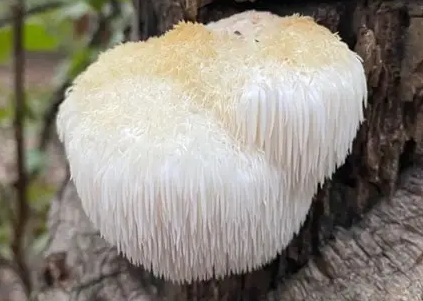
Lion’s mane mushroom has been used for thousands of years by Buddhist monks to increase focus during meditation:
Helps improve cognition – Enhances activity of choline acetyltransferase, which is the enzyme responsible for the synthesis of the neurotransmitter Acetylcholine (Ach), having important roles in memory, thinking, and learning, and also involved in motor movement
Stimulates brain cell growth. Helps promote production of nerve growth factor (NGF), a protein that plays a crucial role in maintaining and regenerating neurons.
Prevent neuronal damage – with its antioxidant activities
There are two main beneficial components of lion mane:
Hericenones
Erinacines
Effective forms of Lion's Mane mushrooms for therapy
Extracted from only the fruiting bodies (not mycelium) of mushrooms. Mushrooms begin as spores which mate and become networks of “hungry” substrate-eating mycelium, which starts fruiting and turns into mushrooms when it becomes full of nutrients
Dual extracted in both alcohol and water. Alcohol extracts hericenones and hot water extracts erinacines. Alcohol breaks down indigestible fibers
Not raw. An indigestible fiber in the mushroom, called “chitin”, blocks absorption of the beneficial compounds
Not powders – simply encapsulated ground up lions mane; some may still contain chitin and may be
Prefer grown in the U.S. – mushrooms have to be completely dried before shipping long distances e.g. from China – if not, it can be riddled with toxic mold and bacteria



 for Physical / Mental Health: Magnesium,
Omega-3 ,
C,
D,
Iodine in
“Make-it-Happen” smoothie
for Physical / Mental Health: Magnesium,
Omega-3 ,
C,
D,
Iodine in
“Make-it-Happen” smoothie