Attend to diet, lifestyle & emotional state:

Nutrition  

Exercise

 Water

Sun

Thoughts  

     Air

Rest

Trust

Sex

Leaf logo

Health Happening    

‘No-brainers’ 💡 for Physical / Mental Health: Magnesium, Omega-3 , C, D, Iodine in “Make-it-Happen” smoothie
Red apple clipart

Sugar Sugar - - - 🎵 And you got me wanting you - 🎶

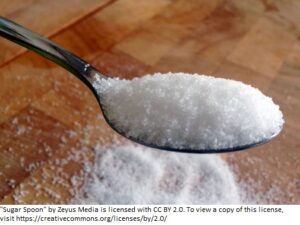
Who doesn't like the taste of sugar?

How to reduce sugar intake      

However, Americans consume table sugar in excessive amounts with serious health consequences

  • Consider the copious amounts of added-sugar (with calories) consumed in soft and sports drinks, fruit juices, and almost all processed foods.     Realize too that sugar is not only in the foods typically acknowledged as sweetened, but its presence also permeates many other processed foods. E.g. Prego spaghetti sauce lists sugar as its second highest ingredient content after tomatoes (containing ~ 2 ½ tsps. / half cup)
  • The U.S. per capita intake of table sugar (sucrose) is about 64 pounds a year. USDA.
  • Refined sugar is in many processed products: E.g. spaghetti sauce, salad dressing, peanut butter, mayonnaise, and ketchup;
  • Excessive consumption of refined sugar is taking its toll on health.  

Too much sugar – A common addiction adversely affecting health

  • We are also consuming too much fructose (particularly present in high fructose corn syrup HFCS)::

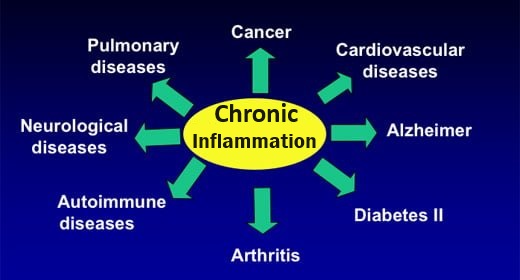
Too much fructose – Burdens liver / Increases inflammation / Favors fat production

If I were president . . .

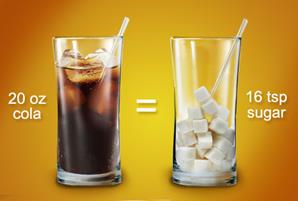
To get across the reality of how much sugar is in a product, this author would change product labeling amounts for sugar from grams or ounces into teaspoons:

1 ounce of sugar / 28.35 grams = ~7 teaspoons

Consider, for example:

ProductTeaspoons of sugar
Coco Cola vitamin water (20 oz) (Should be called “sugar water”)8
Oscar Mayer Lunchables crackers, turkey & American cheese7 ¾
Coca-Cola Classic (12 oz can)8 ¼
Yoplait original yogurt (6 oz)~7
Starbucks Caffé Vanilla Frappuccino Blended Coffee Whip (16 oz)15
Cranberry Juice (Ocean Spray 100% Juice/ no sugar added) (8 oz) – sugar comes from fruit juices8 ½

To figure number of teaspoons of sugar (depending whether sugar content given in grams or ounces):

  • Divide # of grams by 4.    Look at the label where it says “total sugars” and divide the number of grams by four. This computation alone should scare you away!
  • Multiple # of ounces by 7.

Don’t you think that seeing those teaspoon amounts would likely hit home (imagine spooning them in one-at-a-time from a sugar basin!) – Wouldn’t you think twice before consuming them?   Then . . . I NEED YOUR VOTE! 🙂

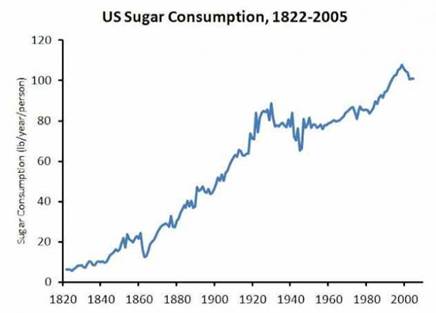
Sugar consumption has escalated over the decades

In 2011, the USDA estimated the average American consumed 12 teaspoons sugar /day.   That’s over 1 ½ tons of sugar in a lifetime!

However, intake of added-sugar (caloric sweeteners) between 1999 and 2008 has SUPPOSEDLY decreased significantly.   A study by Welsh and colleagues concluded that added-sugar intake, although still higher than recommended, had reduced primarily because of a reduction in consumption of sweetened beverages (except energy drinks, which increased).  Welsh, 2011), but read on . . .

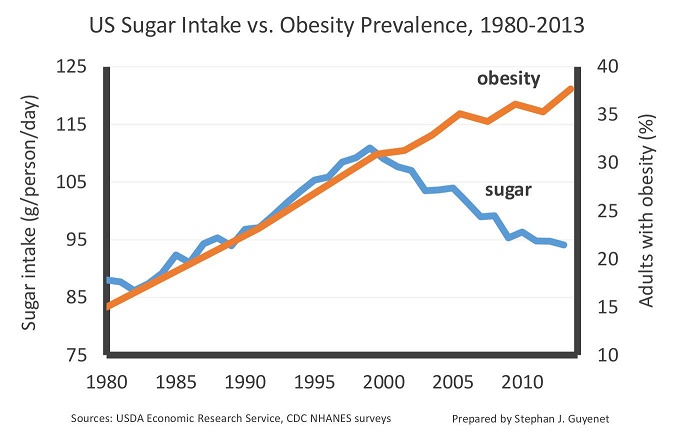
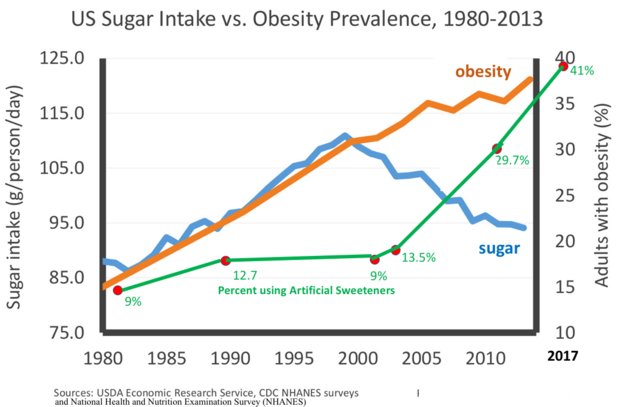
Data from Centers for Disease Control and Prevention NHANES surveys and USDA Economic Research Service food disappearance records provided data for this graph in a 2017 article by academic researcher Dr. Stephan Guyenet, which shows added-sugar consumption on the decline as obesity increased.

However – This USDA data was altered!   Robert Greer, a lawyer who writes about food politics responded to Guyenet in an article entitled “No, sugar consumption hasn’t fallen” that the USDA had altered the data at the (documented) request of the sugar industry. “Around 2011, the USDA changed its methodolgy for determining how much sugar Americans consume, by revising its estimate of how much cane and beet sugar was “lost” (i.e. produced but not eaten) from 20% to 34%. The industry association argued that estimates should be even lower. ” The result: a reported 14% reduction in average per capita sugar consumption in the U.S.  from ~ 88 lbs / person to ~76lbs / person.  Mr Greer concludes in an update to his article evaluating new more credible evidence, that sugar consumption may have fallen slightly off already sky-high levels since around 2000.

Since 2000, added-sugar  (contains calories) has been replaced with no / low calorie non-nutritional sweeteners (NNS).   Although NNS contain no or few calories,  the artificial NNS have never-the-less been shown to cause weight gain and their consumption does correlate with obesity.  

Consuming too much added-sugar is one dietary factor involved in several adverse health consequences

Other health-detrimental dietary factors include: excessive fructose consumption and excessive carbohydrate intake.Lorem ipsum dolor sit amet, consectetur adipiscing elit. Ut elit tellus, luctus nec ullamcorper mattis, pulvinar dapibus leo.

Excess sugar has detrimental effects on hormones controlling blood sugar and appetite

Sugar decreases the receptor sensitivity for both insulin and LEPTIN – causing high blood sugar / insulin resistance (IR), which can lead to:

  • High blood pressure and high cholesterol
  • Heart disease
  • Diabetes
  • Weight gain
  • Premature aging

Sugar increases insulin for the purpose of removing sugar from the blood into cells where it can be metabolized.

 insulin works mainly at the level of most individual cells.  insulin tells each cell whether to burn or store fat or sugar and whether to utilize produced energy for:

  1. Maintenance and repair – equates to increased longevity;
  2. Reproduction

Chronically high insulin levels reduce sensitivity of insulin receptors.   This is referred to as insulin resistance (IR), with consequential high blood glucose levels and so called metabolic syndrome, increasing risk of such as type 2 diabetes, heart disease, obesity and premature aging

Sugar increases LEPTIN (the “satiety” hormone, produced by fat cells).   At first sight, this may seem like a good thing, but read on . . .

LEPTIN works at the level of the whole body of cells.   It controls energy storage and utilization of the entire republic of cells, communicating with the brain as to whether the body has stored or burned enough energy, whether to be hungry and make more fat, whether it is a good time (nutritionally speaking) to reproduce or not, and whether to maintain / repair yourself.

LEPTIN sends signals that:

  • Reduce hunger,
  • Increase fat burning
  • Reduce fat storage

However, due to chronically high levels of LEPTIN, in almost all overweight and obese people their LEPTIN receptors have become resistant (even though they have excess LEPTIN), and the LEPTIN signal is not being “heard” –  i .e. the body can no longer “hear” the messages telling it to stop eating and burning fat – and so it remains hungry and stores more fat.

LEPTIN – Weight Control Hormone

Sugar consumption triggers addiction process

Eating sugar triggers the brain to produce opioids initiating the addiction process.   i.e. the brain becomes addicted to stimulating release of its own opioids in just the same way as partaking of morphine, heroin, cocaine, alcohol, cannabis and nicotine

Long-term stimulation of the brain’s pleasure center (nucleus accumbus) drives the addiction process.   On consumption of an addictive substance such as sugar, the pleasure centure receives a DOPAMINE signal and you sense pleasure. Receiving pleasure is in fact essential to your will to live, but you can overdo this need by chronically supplying the addictive substance . . . such that the prolonged DOPAMINE exposure causes the signal to weaken and you need more of the addictive substance to get the same effect. This is called TOLERANCE. If you stop providing the addictive substance you go into WITHDRAWAL .

TOLERANCE + WITHDRAWAL = ADDICTION

This biochemical force is not likely to be overcome with cognitive willpower, according to Dr. Robert Lustig, professor of pediatrics at the University of California, San Francisco, who has been a pioneer in understanding sugar metabolism.

It is speculated that high sugar diets also overstimulate the two sweet receptors on the tongue – which in turn may be over-stimulating the brain’s reward signals

 

Sugar makes you fat

Over-consumption of sugar causes obesity.    Today’s level of added-sugar consumption (mostly sucrose / table sugar and HFCS) is undoubtedly a major factor in the growing numbers of those who are obese.

Chronic overconsumption of sugar contributes to receptors become insensitive to the messages of insulin  and LEPTIN.   i.e. promotes weight gain

Body stores excess sugar (and other carbs) as fat.   The body converts different forms of sugar into glucose, which it uses to provide energy, especially if you are active. If you consume more sugar than you are using, a limited amount is stored for later use in the liver and muscles, but when those small “storage bins” are full, sugar is converted to fat and stored where we can all see it!

Carrying excess weight around will increase your risk for deadly conditions.    E.g. heart disease, kidney disease, and diabetes.

Today’s obesity problem may be more a result of fructose replacing glucose consumption in mega amounts.   Fructose consumption has increased significantly in the last 4 decades:

  • HFCS has replaced 50% of U.S. sucrose consumption since the early 70’s.   SInce this time it should also be noted that caloric intakes of sugar, fats and carbohydrates have also increased
  • Fructose is metabolized differently to glucose and places a significant burden on the liver .    This can cause related health problems
  • ~ 1/3 of fructose calories are stored as fat .      Compare this to ~1/100 of glucose calories
  • Fructose reduces postprandial insulin response   This can lead to insulin resistance and then metabolic syndrome/ T2 diabetes

Too much fructose burdens liver / Increases inflammation /favors fat production

Do you think the U.S. has a weight or diabetes problem?

  • An estimated almost 1/3 of Americans aged 20 – 74 are now obese, an additional 1/3 are overweight.    Obesity rate has doubled since 1975.  Ogden CL, Carroll MD, McDowell MA, Flegal KM. Obesity among adults in the United States—No statistically significant change since 2003-2004. NCHS Data Brief No. 1. Hyattsville, MD: National Center for Health Statistics; 2007. p. 1-8
  • An estimated 1 out of 3 U.S. children are obese!   This author is irritated that the U.S. Department of Family and Children will diligently investigate a claim brought by a teacher who thinks a child looks too thin and underfed, but it is not considered a possible abuse when a child is seen to be significantly overweight
  • Obesity is the number one reason why applicants fail to qualify for military service.   A report by retired admirals and generals found that 27% potential young recruits (~15,000 /year) fail their entrance physicals due to being overweight and a whopping 75% of young people would not qualify to join the military for the same reason. Report by Mission: Readiness, an organization made up of retired admirals and generals
  • Average global body weight is 136 pounds compared to 177 pounds in North America.    Calculated by scientists using 2005 WHO data
Oxidation rates (represents conversion) of fructose & glucose Sun, 2012
  • Compare less than 3 cases of diabetes per 100,000 people in the U.S. in 1893 to today, with diabetes striking almost 8,000 out of every 100,000 people.   i.e. 8.3% of the population!  “2011 National Diabetes Fact Sheet,”January 26, 2011,American Diabetes Association

How to reduce sugar intake

Tactics to consume less sugar

  • Read labels.   Many products contain “hidden”sugar
    • Sugars can be identified as: sugar, white sugar, brown sugar, cane sugar, confectioner’s sugar, corn syrup, crystallized fructose, dextrin, honey, invert sugar, maple syrup, raw sugar, beet sugar, cane sugar, corn sweeteners, evaporated cane juice, glucose-fructose, granulated fructose, high fructose corn syrup (HFCS), fructose, malt, molasses, and turbinado sugar
    • Avoid products having sugar as any of the first 3 ingredients
  • In coffee / hot chocolate, substitute sugar with cinnamon or a cinnamon stick, or vanilla essence or bean
  • In baking recipes
    • Reducing sugar by one-third won’t usually make much difference to taste
    • Substitute 1/3 sugar with unsweetened apple sauce
    • Use vanilla, cinnamon, nutmeg, cloves toadd sweetness to a recipe
  • Use fruit purees instead of syrup
  • Minimize / Eliminate sweetened soda, tea and other soft drinks.    instead prefer water with a splash of lemon or lime juice
  • Buy plain, unsweetened yogurt and add your own sweeteners.   E.g. banana or other fruit, vanilla, cinnamon, a little honey
  • Avoid processed fruit juice of all types.    if you make your own, limit yourself to 4oz/day
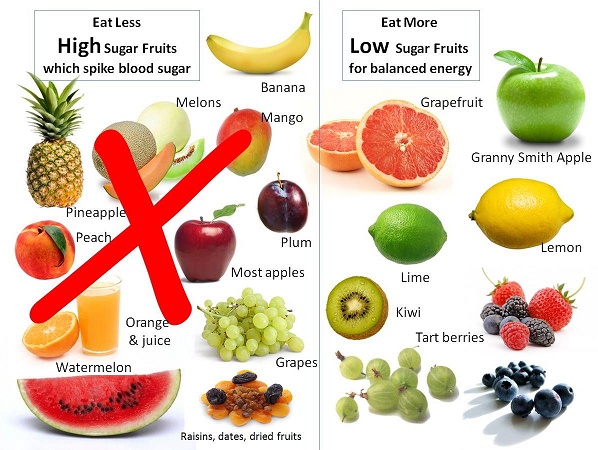
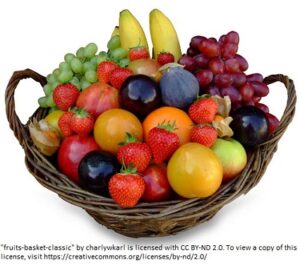
  • Don’t overdo the high-sugar content fruits:

How to overcome sweet cravings

Sweets have been shown to be more addictive than cocaine

“An astonishing 94 percent of rats who were allowed to choose mutually-exclusively between sugar water and cocaine, chose sugar. Even rats who were addicted to cocaine quickly switched their preference to sugar, once it was offered as a choice. The rats were also more willing to work for sugar than for cocaine. The researchers speculate that the sweet receptors (two protein receptors located on the tongue), which evolved in ancestral times when the diet was very low in sugar, have not adapted to modern times ‘high-sugar consumption. Therefore, the abnormally high stimulation of these receptors by our sugar-rich diets generates excessive reward signals in the brain, which have the potential to override normal self-control mechanisms, and thus lead to addiction. ”   Magalie Lenoir, Fuschia Serre, Lauriane Cantin, Serge H. Ahmed. Intense Sweetness Surpasses Cocaine Reward   pdf  www.mercola.com
  • It may be necessary to break the addiction cycle by completely avoiding sweetened products-to restore normal levels of the hormones insulin and LEPTIN, which play a role in keeping you addicted to sweets


  • Using the simple yet powerful Meridian Tapping Technique (MTT) helps overcome addiction

MTT

  • Exercise, particularly regular cardiovascular exercise seems to reduce food cravings, especially for sweets
  • Black coffee may reduce addictive power of sugar – in its role as a potent opioid receptor antagonist;both caffeinated and decaffeinated coffee contain compounds such as cafestrol,which can bind to opioid receptors, blocking addiction to sugar and other opioid-releasing foods. Clin Exp Pharmacol Physiol. 2012 Feb 14;      Nature. 1983 Jan 20;301(5897):246-8.
  • Detoxifies
  • Boosts immune system / cellular energy
  • Anti-inflammatory / Pain-relief
  • Aids sleep / Reduces stress
  • Accelerates healing of tissue, bone, muscles, scars
  • Improves circulation +++

Successful electrotherapies

Amino acid-related: