



Hormones 101 - "Feel good / Look good
What do hormones do?
Derived from the Greek word 'hormao', hormone means to excite or stir into action
Hormones regulate the body’s biochemical reactions for everything the body does and makes. A balanced hormone presence will decrease the symptoms of aging (aging skin, memory loss, fatigue, aches /pains / stiffness, shortened life-span) and restore vitality, sexuality, a slim figure, a good attitude, healthier bones, a healthier heart, and a sharper brain.
Present in all multi-cellular organisms, a hormone is a “communication device”. In the form of a chemical messenger that transports a signal via the bloodstream from one or more cells to other cells in the organism, to affect a change in the receiving cells. Only a small amount of hormone is required. Different hormones work together to regulate many body functions, including:
- Mood / Stress response
- Tissue function
- Reproduction /Sexual function
- Growth and development
- Metabolism E.g. Mineral metabolism

Hormones must be in balance
When your hormones are in balance you will:
- Sleep well
- Have energy in abundance
- Have a strong sex drive
- Have an efficiently functioning immune and digestive system
Conversely, when your hormones become imbalanced, a number of symptoms can present, including:
- Adrenal fatigue
- Hypothyroidism and Hyperthyroidism
- Polycystic Ovary Syndrome (PCOS)
Most hormone imbalances develop over time as a consequence of lifestyle patterns. Only a few imbalances result from endocrine organ malfunctions.
- Chronic stress resulting in CORTISOL imbalance is often the culprit. Not only is CORTISOL the primary hormone for responding to stress, it is also primarily involved in helping your body convert food into energy, normalize blood sugar and maintain your immune system’s inflammatory response. Unbalanced CORTISOL also deregulates female hormones. Thus, for example, hormonal symptoms experienced by women before, during and after menopause are largely avoidable by attending to lifestyle choices that affect stress on the body.
- The response to stress that will interfere with hormonal balance is triggered by emotional, dietary or painful/inflammatory events. For example, work stress, financial worries, relationship problems, poor diet (e.g. too much sugar, refined carbs, processed food and damaged fats, not enough good fats, antioxidants and water), exposure to toxins.
Correcting a hormone imbalance requires an holistic, lifestyle approach before hormone replacement:
- Apply the NEWSTARTS protocol to your life
- In particular, address past and present emotional trauma. Using available “tools”, such as prayer and meridian tapping techniques (MTT)
- That done, ensure your adrenal hormones are in balance. Weakened adrenals will not allow your hormones to attain balance.
Having addressed the above issues, you could now consider some specific bio-identical hormone therapies
The endocrine organs / glands and their hormones
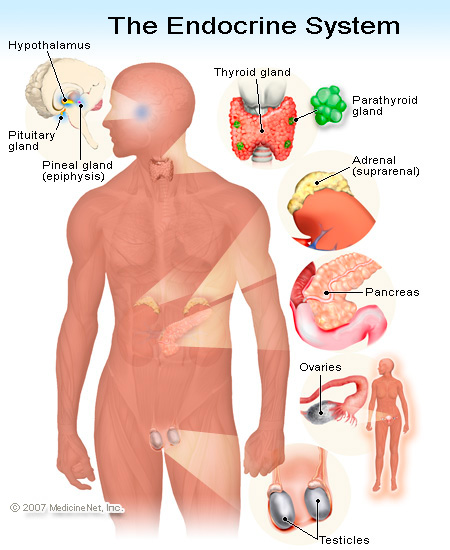
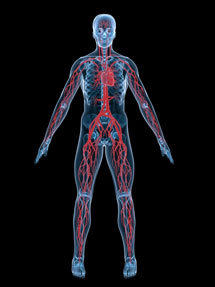
Endocrine tissues or glands contain specialized cells that synthesize, store, and release hormones directly into the bloodstream. From there they can travel to anywhere blood circulates. The endocrine glands are central to regulating and normalizing all the body’s interconnected systems. In contrast, exocrine glands / organs secrete substances into ducts
Brain (sends signals) → Hypothalamus (secretes releasing hormones) → Pituitary gland (produces stimulating hormones) → Target gland (secretes hormones) → Target tissues
A series of glands that communicate in this way is known as an endocrine axis. One example is the hypothalamic-pituitary-adrenal (HPA) axis
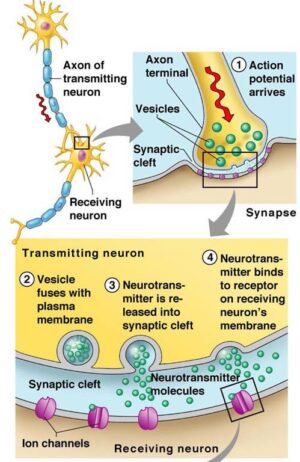
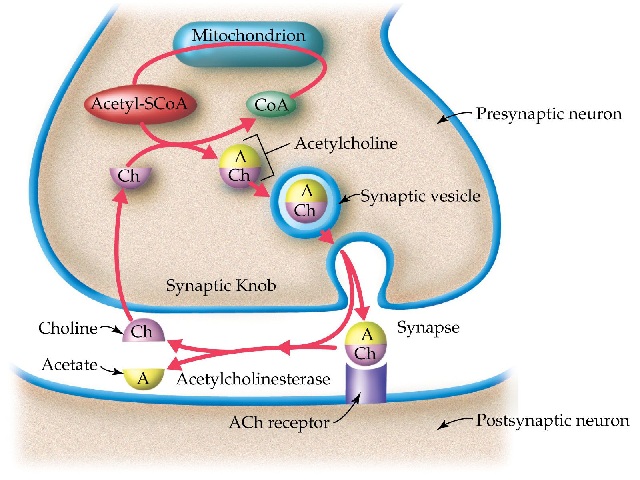
Some hormones are also neurotransmitters, such as SEROTONIN, MELATONIN and DOPAMINE, which enable the nervous system to communicate rapidly via electrical nerve impulses, but do not have the longer-lasting effect of hormones in the blood.
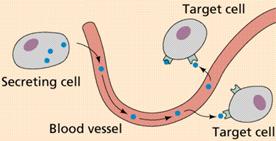
Hormone-producing cells produce one of three types of hormones:
Amines
Water-soluble, produced from amino acids – for example:
- Thyroid hormones – Thyroxine (T4), Triiodthyronine (T3) produced from tyrosine;
- Catecholamines – produced by sympathetic nervous system activation, they include EPINEPHRINE (ADRENALINE), NOREPINEPHRINE and DOPAMINE, controlling autonomic arousal, fight-or-flight stress response, and reward response.
Polypeptides
E.g. pituitary ACTH, insulin, parathyroid hormone);
Steroids
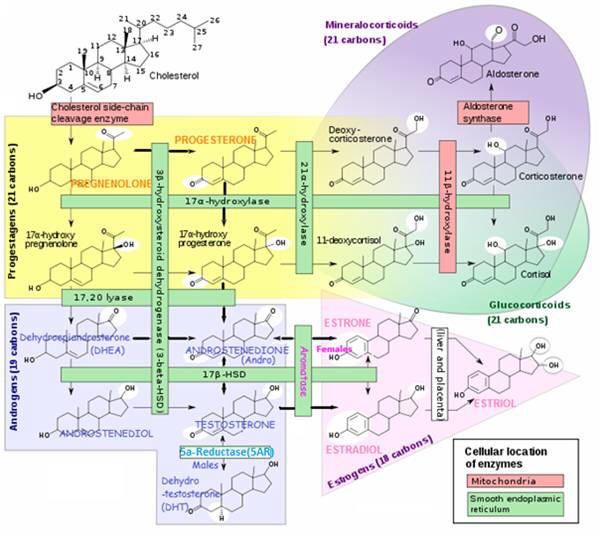
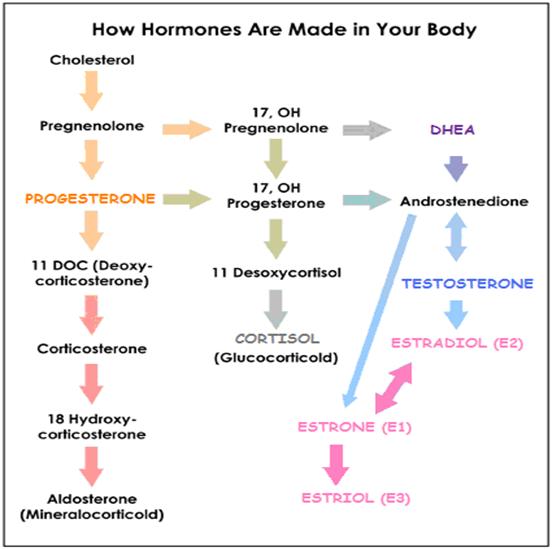
Fat-soluble, produced from cholesterol:
- Glucocorticoids: E.g. Cortisol
- Mineralocorticoids: E.g. Aldosterone – involved in sodium retention;
- Sex steroid hormones Androgens (E.g. Testosterone), estrogens (E.g . estradiol, estrone, estriol) and progestagens (E.g. progesterone).
- Sterols: Vitamin D (E.g. Calcidiol, calcitriol). Closely related to and considered as steroid hormones).
Endocrine glands or organs produce the 3 types of hormones
The following chart gives a few examples – for a more comprehensive list see:
| Endocrine organs / glands | Hormones Secreted | Target Organ | Hormone Function |
|---|---|---|---|
| Pineal Gland |
MELATONIN | Body | Controls circadian rhythms. |
| Posterior Pituitary Gland |
Antidiuretic hormone (ADH) | Kidneys | Increases reabsorption of water |
| OXYTOCIN (neurotransmitter) | Mammary glands | Stimulates release of milk | |
| Thyroid | Triiodothyronine (T3), Thyroxin (T4) |
General | Increases cellular metabolism; |
| Calcitonin | Bone | Stimulates osteoblasts/bone construction; Lowers blood Ca2+ | |
| Pancreas (alpha cells) |
GLUCAGON Neurotransmitter |
Liver | Increases blood glucose |
| Pancreas (beta cells) |
Insulin | Liver, muscles, fat |
Lowers blood sugar levels; stimulates glucose, protein, and fat metabolism; |
| Testes |
Estrogen | ||
| Androstenedione | |||
| Testosterone | Testes, general | Testicle development. Sperm Growth and maturation; Growth of Penis; Stimulates prepubescent facial / body hair growth and voice deepening and aids development of thick masculine muscles. |
|
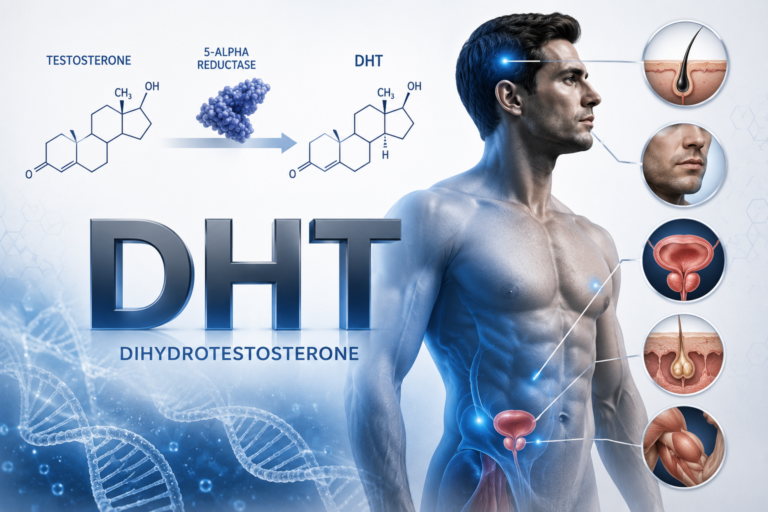
| DHT | A metabolite of TESTOSTERONE , the more potent DHT has an essential role in formation of male embryo’s external genitals, in the adult DHT acts as the primary androgen in the prostate and hair follicles (including women); DHT has significant roles in development of male secondary characteristics, also has role in prostate enlargement (BPH) /cancer; |
||
Progesterone |
|||
| Relaxin | Enhances sperm mobility | ||
| Adipose Tissue |
Leptin (protein hormone) | Strong appetite suppressant, increases metabolism | |
| Adiponectin; Resistin |
|||
| Hair Follicles |
Corticotropic releasing hormone Adrenocorticotropin hormone (ACTH) Cortisol |
Not a classic endocrine organ. Their hormones act locally rather than systemically (via the bloodstream). |
Target Cells and hormonal effects
Target Cells respond to a hormone if they contain the specific receptors for that hormone
The hormone binds to the receptor (like a key in a lock) to give the cell instructions (the activated response is called a signal transduction pathway) specific to the cell type.
(1) Inside the cell. E.g. most steroid hormones enter the cell to initiate a slow process as they unite with either a receptor in the cytoplasm or the nucleus to form a hormone/receptor complex that:
(a) Has a genomic effect. Complex moves into the nucleus (if not already there), where it attaches directly to special DNA binding sites and affects gene transcription of hormone-responsive genes; an mRNA molecule is formed, which is transported to the cytoplasm , where proteins are synthesized to mediate the effect of the hormone. This cytoplasmic/nuclear interaction (classic pathway) takes minutes or hours.
(b) Has a non-genomic effect. Initiates a series of fast reactions in the cytoplasm and does not affect gene transcription.E.g. Estrogen can: (i) Trigger nitric oxide production, (ii) Flood the cell with calcium, or(iii) Initiate hormone release.
(2) On the cell surface. E.g epinephrine, norepinephrine and peptide hormones (“First messengers”) bind to a receptor on the membrane surface setting off a cascade of reactions, which proliferate “Second messengers”inside the cell, which affect existing proteins within the cell. Typically this process is much faster than those that bind to internal receptors and influence creation of new proteins (as in (1a) above)
Hormone effects are complex
- Different receptors within a cell can recognize the same hormone and trigger different actions
- Several cell types can recognize the same hormone and trigger action in a number of different tissues. Different tissue types may respond differently to the same hormonal signal. E.g. INSULIN triggers a diverse range of physiological effects.
- Different hormones and their receptors can trigger the same action (by the same biochemical pathway)
Hormone Receptors determine the level of response to a hormone
Hormone receptor locations
- Many hormone receptors are embedded in the plasma membrane (at the cell surface)
- Most hormone receptors for steroid and thyroid hormones are in the cytoplasm inside the target cell. To bind to these receptors, the hormones must cross the cell membrane forming a combined hormone-receptor complex.
Amplification /Suppression of hormone signal. A hormone-receptor complex formed in the cellular cytoplasm then moves across the nuclear membrane into the cell nucleus, where it amplifies or suppresses actions of certain genes affecting a cellular response of protein synthesis in muscles and bones.
Concentration of Hormone-Receptor complexes dictate the level of response to a hormone. These concentrations are determined by:
- Number of hormonemolecules. Available for complex formation (Usually the key factor);
- Number of receptor molecules. Available for complex formation;
- Binding affinity. Between hormone and receptor.
Exocrine organs / glands and their secretions
Exocrine organs produce substances that travel through ducts to a specific destination external to the gland.
| Organ | Exocrine Function |
|---|---|
| Salivary glands | Produce saliva containing enzymes that begin digestion. |
| Pancreas | Releases digestive enzymes and bicarbonate into the small intestine. |
| Liver | Produces bile to aid digestion of fats. |
| Gallbladder | Stores and releases bile into the small intestine. |
| Sweat glands | Secrete sweat to regulate body temperature. |
| Sebaceous glands | Produce sebum to lubricate skin and hair. |
| Lacrimal glands | Produce tears to lubricate and protect the eyes. |
| Mammary glands | Produce milk during lactation. |
| Mucous glands | Secrete mucus that protects and lubricates body surfaces. |
Some exocrine organs contain an endocrine gland portion and a duct portion.
For example:
- The pancreas: Endocrine gland portion of the pancreas release the hormones insulin, GLUCAGON and SOMATOSTATIN; Duct portion of the pancreas secretes pancreatic juice to aid digestion;
- The liver: secretes INSULIN-like growth factor hormones IGF-1 and IGF-2, angiotensinogen, hepcidin and thrombopoietin to regulate growth, blood pressure, platelet production, and iron metabolism; and its exocrine function is to produce bile, delivered through bile ducts to digest fats, absorb fat-soluble vitamins and eliminate bilirubin and excess cholesterol.
- The stomach: Its exocrine glands secrete acid, digestive enzymes, mucus, and intrinsic factor into the stomach, while its endocrine cells release hormones such as gastrin, ghrelin, and somatostatin into the bloodstream to regulate digestion and appetite.